Crafters: Avoid a 500 Piece Mistake Buying Bulk Laser Cut Wood Shapes
For most crafters and small shop owners, the smart move is buying ready-made bulk packs for standard shapes and saving custom orders for personalization or unusual sizes. A specialty laser shop like Signature Laser Designs makes sense once you need one-off dimensions, engraved details, or gift-ready pieces. Whichever route you pick, filter every option by material, thickness, and minimum order quantity before you commit.
✦ Featured From Our Shop ✦
Handcrafted & laser engraved in Georgia, just for you
TL;DR:
- Bulk orders are usually priced lower per piece when ordering standard shapes in larger quantities, often starting from 500 units or more.
- Most suppliers ship stock shapes quickly within a few days, but custom runs require additional time for setup, proofing, and quality checks.
- Selecting the correct material depends on the project’s purpose, with Baltic birch and basswood being the most versatile options for craft and resin projects, respectively.
- Testing samples before bulk purchasing helps identify issues with fit, finish, and kerf tolerance, saving time and costs in the long run.
- Small laser shops are better suited for personalized, low-volume orders, especially when customization, quick turnaround, or specific sizes are required.
Table of Contents
- What Are the Best Materials for Bulk Laser-Cut Wooden Shapes?
- What Should You Check Before Placing a Bulk Order?
- How Do Sizes, Minimums, and Lead Times Work for Bulk Orders?
- Which Finishing Options Actually Save You Time?
- What Does Bulk Laser-Cut Wood Actually Cost?
- Why Small Laser Shops Beat Big Factories for Custom Craft Orders
- Ready to Order? Here’s How Signature Laser Designs Can Help
- Sources
- FAQ
What Are the Best Materials for Bulk Laser-Cut Wooden Shapes?
Material choice determines almost everything downstream: how the paint sits, whether resin beads up or soaks in, and how much sanding you’ll do before a piece is sellable. Get this wrong on a 500-piece order and you’re stuck reworking every single unit by hand.
Baltic birch plywood is the workhorse for most bulk craft projects. It has a tight, even grain with minimal voids, which means fewer surprises when you slice through it with a laser. The face sands clean, takes paint evenly, and holds up well under repeated handling, which matters when you’re packing dozens of ornaments for a holiday market table.
Basswood runs softer and lighter in color, almost blond compared to birch’s warmer tone. It’s a favorite for anything going into resin art because the open grain drinks up sealer evenly, preventing the blotchy look that ruins an otherwise nice piece. Basswood also engraves with a lighter char mark, so text and fine details read cleaner without extra cleanup.
Poplar plywood splits the difference. It’s a bit more affordable than birch, still paints reasonably well, and works fine for shapes that will be primed heavily anyway, like layered signs or thicker cutout letters.
MDF (medium-density fiberboard) is the budget option, and it has real limits. It’s dense enough to cut cleanly and holds paint well on flat faces, but it’s more prone to swelling if it gets damp, and it tends to fuzz at the edges more than solid wood plies. Skip it for anything going near resin, since MDF absorbs unevenly and can warp.
A few practical notes on how the laser itself treats your material:
- Laser cutting typically holds dimensional precision within about 0.2 millimeters, which is why a batch of 1,000 identical ornament blanks actually comes out identical, not just close.
- Cut edges will show a light char line, more visible on basswood than birch, and it usually sands off in one light pass.
- Many bulk suppliers ship pieces with a protective backing paper still applied from the cutting process, which you peel off before priming or painting.
- Thin stock (1/8 inch) shows char more than 1/4 inch stock simply because there’s less surface area to distribute heat.
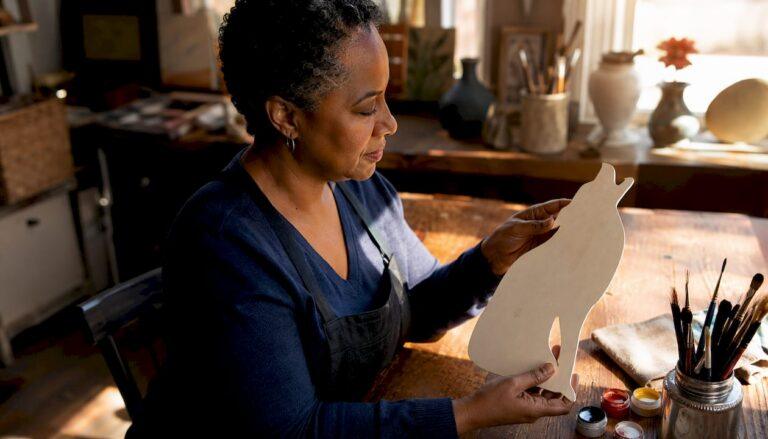
Shape families matter here too. Ornament rounds, stars, and snowflakes are almost always cut from thinner 1/8 inch stock since they’re lightweight and often hung. Standalone letters, monograms, and freestanding signs usually need 1/4 inch or thicker just to keep from snapping when someone picks them up. Animal silhouettes, state outlines, and novelty shapes like Signature Laser Designs’ Howling Wolf Wood Cutout in 1/4 inch plywood fall into this sturdier category, giving you enough material to engrave detail without the piece feeling flimsy.
Wall décor and display pieces, like a guitar cutout sign cut with precision detailing, tends to need thicker stock too, since they’re meant to hang and hold their shape over years, not just a single event.
Pro Tip: If you’re unsure which material fits your project, order one sample piece in birch and one in basswood before committing to a bulk run. The five minutes it takes to test paint and resin on both saves you from reordering an entire batch later.
What Should You Check Before Placing a Bulk Order?
Buying in bulk rewards preparation. A rushed order on hundreds of pieces multiplies any mistake by however many units you bought, so a short checklist upfront beats damage control later.
Before you request a quote, confirm these six things with any supplier:
- Material and finish. Ask exactly which wood species or plywood grade they use, and whether the surface is sanded or raw.
- Thickness and strength. Match the stock thickness to how the piece will be used. Thin 1/8 inch works for flat ornaments; 1/4 inch or more suits anything freestanding or handled often.
- Dimensional tolerance. Ask what kerf and tolerance the laser holds. Reputable cutters typically run kerf around 0.2 millimeters with accuracy near ±0.13 millimeters, tight enough that pieces from the same batch will match.
- Pre-drilled holes or hanging features. If you need ornament loops or mounting holes, confirm they’re included in the base price, not an add-on you’ll discover later.
- Packaging and damage protection. Ask how pieces are packed for shipping, especially for thin or detailed cutouts that can snap in transit.
- Customization and engraving options. Find out whether logos, names, or dates can be added to the run and at what minimum quantity.
Once you’ve got answers, move through the order itself in a sequence that protects you from a costly mistake:
- Request a sample. Get one or two physical pieces before committing to hundreds. A photo on a listing page never tells you how the wood feels or sands.
- Test the finish. Run your actual paint, stain, or resin on the sample under normal conditions, not rushed.
- Confirm the proof. For anything customized or engraved, get a written or digital proof approved before production starts. This is your last checkpoint to catch a wrong font size or misspelled name.
- Place the order. Lock in quantity, thickness, and finish details in writing, including the agreed lead time.
Sample testing before a bulk commitment is one of the highest-return steps in this whole process. It costs you a few dollars and a couple of days, but it catches kerf and fit problems before they become a 500-piece headache.
Pro Tip: If your project involves pieces that need to interlock or nest together, like layered signs or puzzle-style ornaments, always confirm kerf tolerance on the sample first. A difference of even a few tenths of a millimeter can mean the difference between a snug fit and a piece that wobbles.
How Do Sizes, Minimums, and Lead Times Work for Bulk Orders?
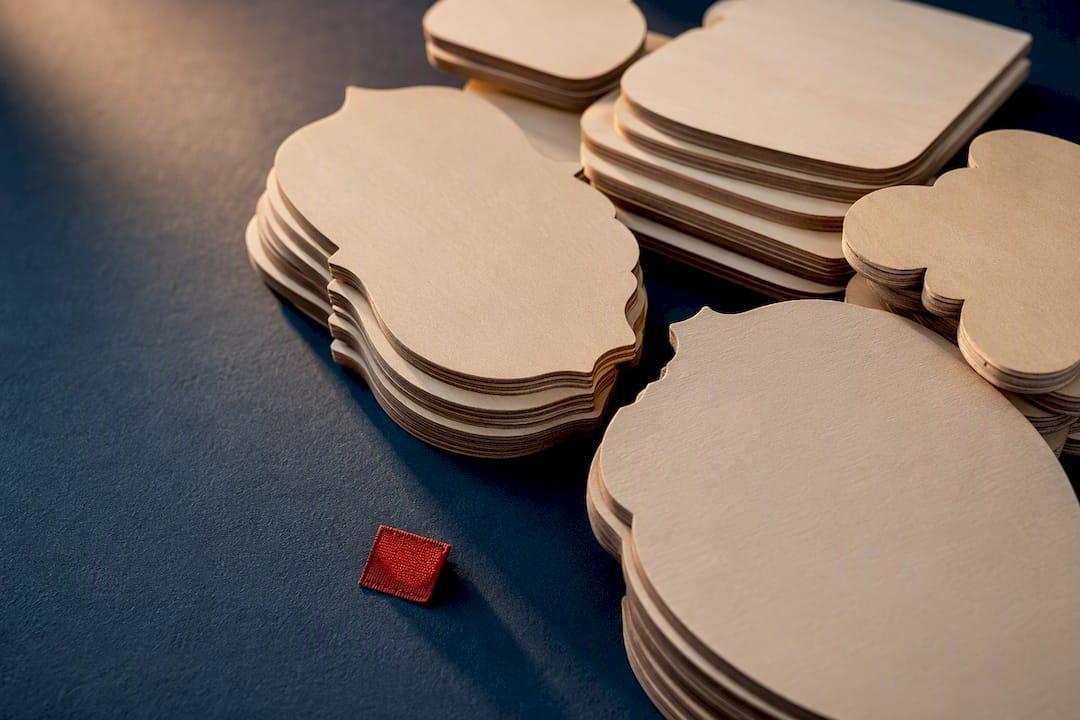
Stock sizes and thicknesses follow a predictable pattern across most suppliers. The most common bulk craft shapes run 1/8 inch or 1/4 inch thick, with finished dimensions between 4 and 12 inches for things like ornaments, letters, and small signs. Thicker stock, generally 1/4 inch and up, gets chosen for anything that stands alone or gets handled repeatedly, since thinner material flexes and eventually cracks under regular use.
Minimum order quantities vary widely depending on who you’re buying from. Wholesale factories often set MOQs in the thousands, and you’ll see listings for bulk 1,000-piece packs of 1/8 inch Baltic birch cutouts sized around 4 to 5 inches, aimed at classrooms, camps, and resale booths. Boutique laser shops work differently. Because they cut smaller batches on demand, their MOQs tend to sit much lower, sometimes as few as a dozen or two pieces, which makes them the better fit when you want a specific size or a personalized run rather than a generic stocked shape.
Lead times split along the same lines:
- Stocked packs ship fast, often within a few business days, since the shapes are already cut and sitting in inventory.
- Custom runs take longer because the design has to be set up and proofed before the laser ever starts cutting.
- Larger quantities generally add days, not because the cutting itself takes longer per piece, but because sorting, packing, and quality checks scale with volume.
- Some cutters offer same-day quoting and production for smaller custom jobs, which is worth asking about if you’re on a tight timeline for an event or market date.
Shipping deserves its own thought, especially once you’re ordering hundreds of pieces. Parcel shipping works fine for smaller bulk orders, but once a box starts pushing toward 20 or 30 pounds of stacked wood, freight shipping often becomes the cheaper option per unit, even though it takes longer to arrange. Ask any supplier directly at what quantity they switch recommendations from parcel to freight. If you’re buying from a boutique shop for a custom run, our guide on ordering unfinished wood cutouts in bulk walks through what to expect at each step.
Which Finishing Options Actually Save You Time?
The right finishing choice can be the difference between spending a weekend sanding and priming versus opening a box that’s ready to sell. Suppliers typically offer some combination of the following:
- Sanding. Smooths the cut edges and face, removing any light char from the laser.
- Priming. A base coat applied before shipping, which cuts your prep time dramatically if you’re painting a large batch.
- UV printing. Full-color designs printed directly onto the wood surface, useful for signs or decor pieces that need more than a single paint color.
- Engraving. Adds names, dates, or logos burned into the surface rather than painted on, which holds up better over time.
- Pre-drilled holes. Saves you from drilling hanging holes or mounting points one by one across hundreds of pieces.
Whether pre-finishing is worth the extra cost depends on your business model. If you’re running a resin art class or a paint-your-own-ornament event, raw sanded blanks give your customers the full experience and you keep costs lower. If you’re building resale-ready inventory for a shop or online store, pre-drilled and pre-primed pieces let you skip straight to the fun part, painting and packaging, instead of losing hours on prep work nobody sees.
Resale-ready SKUs work best when you describe them clearly in your store listing: material, thickness, whether holes are pre-drilled, and whether the piece arrives sanded or raw. A listing that says “1/4 inch Baltic birch, pre-drilled, sanded and ready to paint” sells faster than one that just says “wood cutout,” because it tells the buyer exactly what work is left for them.
For anything tied to a gift or event, personalization is where things get interesting. Signature Laser Designs supports small customization runs for exactly this kind of order: a name added to a set of wedding favor tags, a date engraved into a set of anniversary coasters, or a small batch of guitar cutout signs personalized for a music teacher’s retirement gift. This is the sweet spot where stocked bulk packs can’t compete, since a factory running thousands of identical pieces isn’t set up to swap in a different name on unit number 47.
What Does Bulk Laser-Cut Wood Actually Cost?
Pricing on bulk wooden shapes moves in a predictable direction: the more you order, the lower your per-unit cost drops, and the more customization you add, the higher it climbs back up. Stocked bulk packs, like a 1,000-piece run of small ornament blanks, typically land at the lowest per-piece cost simply because the supplier already absorbed the design and setup work across a large production run. Custom orders start higher per piece since someone has to build the cut file, run a proof, and often set up the laser specifically for your job.
A handful of factors push your final quote up or down:
- Wood species and grade. Hardwood species and premium plywood grades (like cabinet-grade birch) cost more than basic construction-grade plywood or MDF.
- Custom tooling and design setup. A brand-new custom shape requires file prep before the first piece ever gets cut, a cost that’s spread thinner across larger orders.
- Engraving area and detail. More surface area covered in engraving, or finer detail requiring slower laser passes, adds time and cost per piece.
- Finishing steps. Each additional step, sanding, priming, drilling, printing, adds a small per-piece cost that multiplies fast across a big order.
- Lead time. Rushed turnaround for a tight event deadline usually comes with a rush fee, since it often means bumping your job ahead of others in the queue.
Here’s a simple example to ground this. Say you need 500 ornament blanks in 1/8 inch birch, sanded and pre-drilled, no engraving. You’d budget for the base per-piece cost of the blanks themselves, add a small per-piece charge for the pre-drilling and sanding, then factor in shipping, which likely shifts toward freight pricing once you’re moving 500 pieces of wood. Costs on custom or specialty orders tend to fall noticeably as order size increases, so it’s worth asking your supplier directly whether crossing from 500 to 1,000 units meaningfully changes your per-piece rate.
Before you commit to any single supplier, get quotes from at least two or three. Ask specifically about tiered pricing breaks, most suppliers have a quantity threshold where the per-unit price drops noticeably, and it’s rarely advertised upfront. A direct question like “what’s your price at 250 units versus 500 units” often reveals a break point you wouldn’t have found otherwise.
Why Small Laser Shops Beat Big Factories for Custom Craft Orders
Bulk factory packs make sense for standard shapes nobody needs to personalize. But the moment a project calls for a specific size, a hand-picked motif, or a name burned into the wood, the economics flip in favor of a specialty shop that can turn around a smaller, tailored run.
That’s the gap Signature Laser Designs was built to fill. A wedding planner ordering favor tags for 80 guests doesn’t need a factory minimum of 5,000 units, she needs 80 pieces that match her color scheme and maybe include the couple’s initials. A small boutique stocking a holiday table doesn’t want to gamble thousands of dollars on a factory MOQ before knowing if the design sells. Working in smaller, faster batches lets a shop say yes to that kind of order without asking the buyer to compromise on quantity or timeline.
Personalization is where this distinction actually matters day to day. A stocked wolf silhouette cutout works fine as-is for a cabin-themed craft fair. But the same shape, engraved with a family name and a moving date, becomes a housewarming gift instead of a generic blank. A guitar cutout sign sold as a plain wall decor piece is nice; the same sign engraved with a band name or a specific model number becomes something a musician actually wants to hang up. That shift, from generic to specific, is almost always what separates a “nice item” from a gift someone remembers.
Deciding between a stocked pack and a custom small run usually comes down to three questions: How complex is the design? Does it need any personalization at all? And how much lead time do you actually have before the event or sale date? If the answer to personalization is yes, or the timeline is tight and specific, a specialty shop willing to run smaller batches almost always serves the project better than a factory built around volume.
— Gary
Ready to Order? Here’s How Signature Laser Designs Can Help
A small-batch laser shop can personalize your order without requiring a very large minimum quantity. If you’ve been quoted a 5,000-unit minimum just to get a name engraved on a set of ornaments, that’s the exact gap this shop is built to close.
Two products already featured in this guide show that range in action. The Howling Wolf Wood Cutout in 1/4 inch plywood works as a rustic, ready-to-decorate blank for cabin décor, gift baskets, or resale booths that lean into nature themes. The Wooden Guitar Cutout Sign fits musicians, teachers, and anyone building out music-themed gifts or wall art, and it’s available across multiple large sizes for display flexibility.
Placing an order is straightforward: request a sample if you’re unsure about material or finish, upload your artwork or personalization details if you want engraving, confirm your thickness and material choice, approve a proof before production starts, and place your order. For bulk blanks and custom-engraved pieces, the blanks and personalized gift catalog covers everything from unfinished wood blanks to fully personalized wood and metal gifts. For a broader look at custom gift creation services, from personalization to small-batch production, visit the custom gift creation page to start a quote today.
Sources
A few sources back the material and pricing claims throughout this guide, useful if you want to dig deeper before placing your own order.
- Making the most of precision wood-cutting — Serralaser
- Laser Cut Wood | Custom Parts | Ponoko
- Wholesale Unfinished Wood Craft Shapes | Bulk 1000 Piece Pack | Faire
FAQ
What’s the typical lead time for a bulk wood cutout order?
Stocked packs usually ship within a few business days since the shapes are already cut and ready to go. Custom runs take longer because of design setup and proofing, though some laser shops offer same-day quoting and quick turnaround for smaller custom jobs.
Should I request a sample before ordering hundreds of pieces?
Yes. Testing a sample piece before committing to a large order lets you confirm fit, finish, and kerf tolerance before you’re locked into hundreds or thousands of units.
Which material works best for resin art versus painting?
Basswood tends to work best for resin projects because its open grain absorbs sealer evenly. Baltic birch is usually the better choice for painting since its tighter grain gives a smoother, more even paint surface.
What if I only need a small custom batch, not thousands of pieces?
A specialty laser shop like Signature Laser Designs is generally the better fit, since boutique shops run smaller batches with lower minimums than wholesale factories. Their custom gift creation services support personalized runs without the high-volume minimums typical of bulk manufacturers.
What return or quality guarantees should I expect on a bulk order?
Policies vary by supplier, so confirm return and replacement terms before ordering, especially for large quantities. Signature Laser Designs’ current terms and ordering details are listed directly on its services page.
Recommended
- Buy Unfinished Wood Cutouts in Bulk for Laser Gifts
- Ohio Wood Cutout Shape: Crafter’s Buying Guide
- Prep Unfinished State Cutouts for String Art: Laser Cut Fixes
- Laser-Cut Wood Cutouts — Custom Décor & Gifts from SigLaserDesigns