Wholesale Custom Laser Engraving: Most Cost-Effective Guide
For most US small businesses, the single most cost-effective way to buy wholesale custom laser engraving is through a domestic contract engraving service like Signaturelaserdesigns, using tiered volume pricing and standardized design specs. Three reasons this route wins: your landed cost stays lower than overseas sourcing once you factor in shipping and import duties, turnaround times are days rather than weeks, and you get quality control that protects your resale margins from the start.
✦ Featured From Our Shop ✦
Handcrafted & laser engraved in Georgia, just for you
That said, two alternatives can beat domestic contract engraving in specific situations:
- Buy your own equipment when your annual volume is high enough that recurring outsourcing costs exceed machine CAPEX plus maintenance. This threshold varies by machine type and order mix, but it rarely makes sense below a few thousand units per year.
- Source overseas when you need very large quantities of a single standardized design, have long lead times built into your supply chain, and have modeled the full landed cost including shipping, import duties, and sample cycles.
For everyone else, domestic contract engraving is the smarter, faster, and often cheaper path once all costs are on the table.
Table of Contents
- How is laser engraving pricing actually calculated?
- How does per-unit price drop as your order size grows?
- What tactics actually lower your per-unit cost without hurting quality?
- Which sourcing route is most cost-effective for your situation?
- What should you include in a vendor RFQ to get accurate quotes?
- A worked wholesale quote showing the math end-to-end
- How do you vet a vendor and negotiate the best terms?
- The recommended path and how Signaturelaserdesigns fits it
- Key Takeaways
- Why domestic contract engraving wins more often than buyers expect
- Signaturelaserdesigns: custom engraving built for small-business wholesale
- Useful sources and tools for running your own numbers
How is laser engraving pricing actually calculated?
Every quote you receive from a wholesale laser engraving supplier should trace back to one formula. Laser engraving pricing follows this structure:
Final price = (Materials + Labor + Machine wear + Overhead) × (1 + Profit margin)
Typical profit margins at reputable service bureaus vary broadly depending on the service and order. Here is what each component actually includes:
- Materials: Raw substrate cost plus a waste/yield factor. A sheet of hardwood with 15% yield loss costs more per finished piece than the raw price suggests.
- Labor: Design time, file cleanup, jig setup, machine run time, and any finishing work like sanding or coating. Design and setup often represent the largest share of labor cost, not the engraving itself.
- Machine wear: Expressed as a cost per production hour, covering laser tube replacement, lens cleaning, and mechanical maintenance. A CO2 laser tube, for example, has a finite lifespan measured in hours.
- Overhead: Electricity, shop space, software licenses (LightBurn, CorelDRAW), and administrative time allocated per job.
Understanding this formula lets you evaluate quotes on equal terms. When a supplier gives you a per-unit price, you can ask which components are bundled and which are charged separately.
Common hidden fees that inflate your real cost
Several charges routinely appear outside the base quote. Watch for these:
- Setup fees: Charged once per job or per design, typically ranging from a flat file-processing charge to a full hour of labor. Ask whether setup is amortized across your quantity or billed as a flat add-on.
- Artwork cleanup fees: If your file is not print-ready vector format, suppliers charge to convert or clean it. Submitting a clean AI, PDF, or SVG file eliminates this entirely.
- Sample or proof costs: Some suppliers charge for a physical sample before running the full order. Always ask upfront whether samples are included or billed separately.
- Rush fees: Compressing a standard 5–10 business day lead time to 48–72 hours can add 20–50% to your unit cost. Plan ahead and you will never pay this.
- Minimum order fees: A supplier with a $50 minimum may charge a “small order surcharge” on quantities below their preferred threshold. Know the MOQ before you request a quote.
Statistic callout: Design automation and template standardization can cut setup time by up to 50% for repeat SKUs, which is often a larger per-unit saving than negotiating a lower raw material price.
How does per-unit price drop as your order size grows?
The steepest savings in affordable bulk engraving services happen between a single unit and the 100-unit mark. After that, gains are real but incremental. Per-unit cost drops most sharply between 1 and 100 units; the 100–500 piece range captures most economies of scale and is the practical sweet spot for small businesses scaling wholesale SKUs. Orders of 1,000 or more can unlock a further 10–25% reduction through long-term contracts, but that additional savings is modest compared to the jump from 1 to 100.

Shipping compounds this effect. For small orders of 1–5 units, logistics can represent a significant share of landed cost. At 100 or more units, that share typically drops to 5–8% per unit, which is why consolidating orders matters so much.
| Order tier | Typical per-unit cost behavior | Shipping as % of landed cost |
|---|---|---|
| 1–5 units | Highest per-unit cost; setup fee dominates | 15–25% |
| 10–50 units | Moderate drop; setup amortized across more pieces | 10–15% |
| 100–500 units | Steepest cumulative savings; sweet spot for most small businesses | 5–8% |
| 500–1,000 units | Incremental gains; worth negotiating a contract rate | 5% |
| 1,000+ units | Further 10–25% reduction possible via long-term agreements | 2–4% |
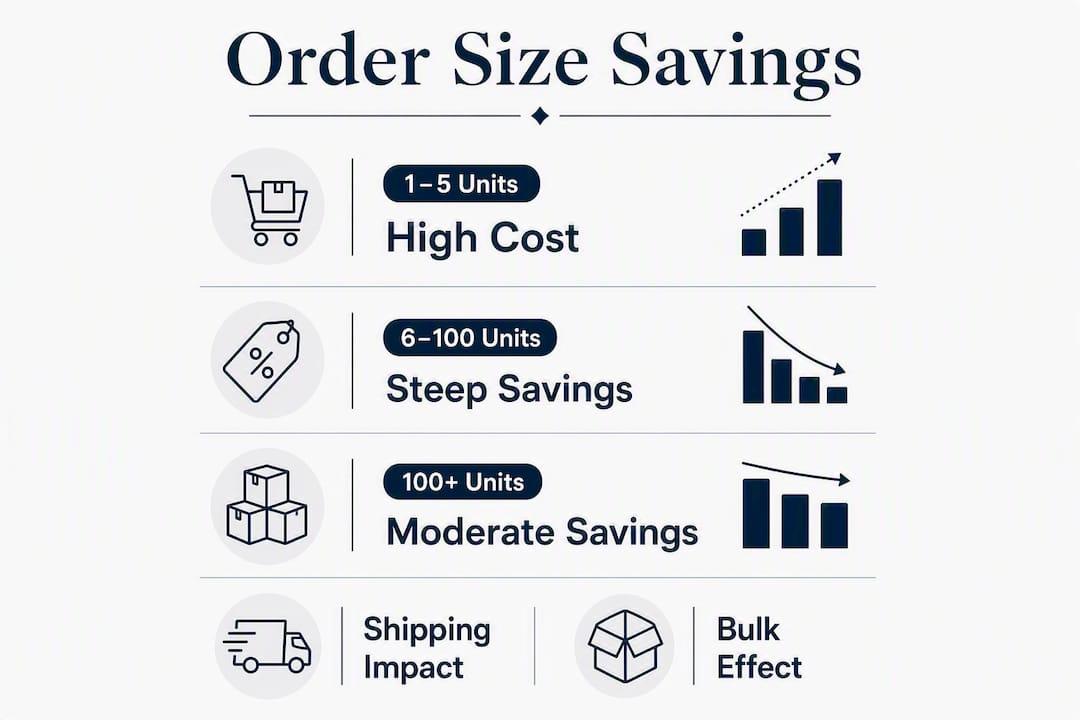
The practical takeaway: if you are currently ordering 10–20 units at a time, consolidating two or three orders into a single 50–100 unit run will cut your per-unit cost more than any other single action.
What tactics actually lower your per-unit cost without hurting quality?
Operational choices inside your order process have a bigger impact on cost than most buyers realize. These are the highest-leverage moves:
Standardize your designs and use templates. Repeating the same layout across SKUs means the supplier sets up once and runs multiple items. Design automation can cut setup time by up to 50% for repeat SKUs, and that saving passes directly to your per-unit price.
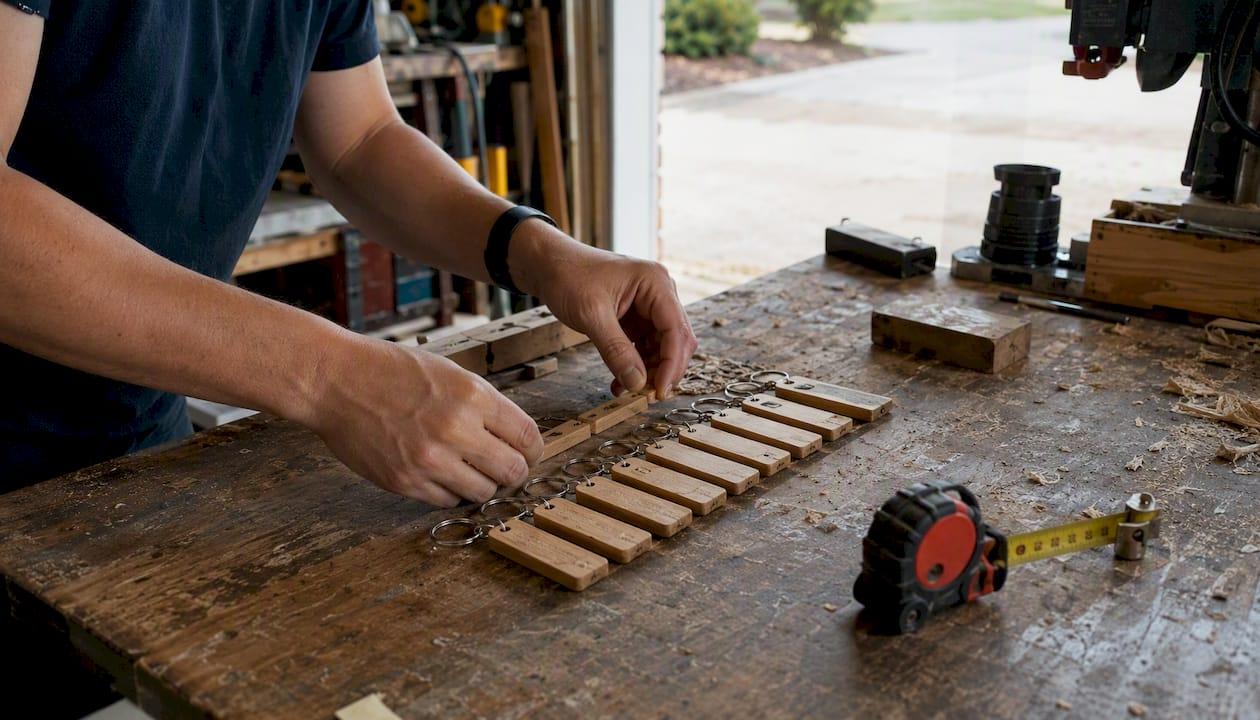
Use jigs and fixtures. A simple jig holds each piece in the same position so the operator does not re-align between items. Jigs and free professional design software like LightBurn and Inkscape can reduce manual touch-time by 20–30%, which improves ROI faster than chasing lower raw material prices.
Choose laser-friendly materials. Anodized aluminum, Baltic birch plywood, and acrylic engrave cleanly with minimal waste. Exotic hardwoods or coated metals often require slower passes and generate more rejects, both of which raise your effective cost per good unit.
Nest your designs on sheets. Sheet nesting places multiple designs on a single substrate sheet, maximizing material yield and reducing per-piece material cost. Ask your supplier whether they nest by default or charge extra for it.
Batch similar SKUs together. If you sell three sizes of the same engraved item, run all three in one job. The setup is nearly identical, and you share that labor cost across a larger total quantity.
Add packaging upgrades strategically. Simple branding additions like custom tissue paper, a branded sticker, or a kraft box can cost $5–$20 per unit and significantly increase perceived value without large production cost increases. Pairing this with automated packaging solutions can keep fulfillment costs low even as your presentation improves.
Pro Tip: Ask your supplier to quote three quantity tiers simultaneously in your first RFQ. The price difference between tiers is visible immediately, and you can decide whether the savings justify ordering more inventory upfront.
Which sourcing route is most cost-effective for your situation?
Three main routes exist for buying wholesale custom laser engraving. Each suits a different buyer profile.
Domestic contract engravers
A domestic service bureau handles everything from file prep to finished product, ships within the US, and operates under US quality standards. MOQs are typically flexible, often starting at 10–25 units, and lead times run 3–10 business days for standard orders. For most small US businesses, this route wins on total cost of ownership because there are no import duties, no customs delays, and no expensive sample cycles before production begins. Rework, when needed, is fast and does not require international shipping.
Signaturelaserdesigns’s industrial laser engraving services (on Etsy) fall squarely in this category, covering wood, metal, and other materials with transparent pricing and domestic fulfillment.
Overseas manufacturers
Overseas suppliers often quote lower unit prices, but the landed cost picture changes once you add ocean or air freight, US import duties (which vary by product category and material), customs broker fees, and the cost of a sample run before committing to a full order. Shipping, import duties, and customs clearance often negate lower unit quotes from overseas suppliers when the full TCO is modeled. Lead times of 4–8 weeks also tie up working capital and make it harder to respond to demand changes.
Buying your own equipment
Many businesses start by outsourcing and later buy equipment once order volumes make in-house production cost-effective. The break-even depends on machine CAPEX versus recurring outsourcing costs. Entry-level diode lasers start under $1,000 but have limited material range; CO2 machines capable of production work typically start at $3,000–$8,000 and require ventilation, maintenance, and operator training. Until your volume justifies that investment, outsourcing keeps cash free for inventory and marketing.
| Factor | Domestic contract engraver | Overseas manufacturer | Own equipment |
|---|---|---|---|
| Per-unit price | Moderate | Lowest (pre-landed) | Lowest at scale |
| Landed cost | Predictable | Variable; duties add cost | Fixed CAPEX + variable ops |
| MOQ | Low (10–25 units typical) | Often 100–500+ units | None |
| Lead time | 3–10 business days | 4–8 weeks | Same day |
| Quality control | High; easy rework | Variable; rework is costly | Operator-dependent |
| Best for | Most small US businesses | High-volume, single design | Very high volume or niche |
Pro Tip: Before committing to overseas sourcing, build a simple landed-cost spreadsheet: unit price + freight per unit + duty rate × unit value + customs broker fee ÷ quantity. Run it at your actual order size. The result often surprises buyers who assumed overseas was cheaper.
What should you include in a vendor RFQ to get accurate quotes?
A complete request for quote (RFQ) eliminates back-and-forth and surfaces hidden fees before you commit. Suppliers who publish transparent MOQ thresholds, tiered pricing, and lead times reduce negotiation cycles and unexpected fees. Your RFQ should give them everything they need to price accurately on the first pass.
Required RFQ fields:
- File format: vector AI, PDF, or SVG preferred; minimum 300 DPI for raster elements
- Material specification: substrate type, thickness, and finish (e.g., 1/8" Baltic birch, natural finish)
- Tolerances: state your acceptable range (e.g., ±0.010" for small parts, depending on material)
- Surface finish: raw engraved, painted fill, clear coat, or other post-process
- Quantity tiers: request pricing at three levels (e.g., 50, 100, and 250 units)
- Packaging: individual poly bag, kraft box, or bulk pack
- Labeling: whether SKU labels or barcodes are needed on packaging
- Desired lead time: your target ship date and whether rush options are available
- Sample policy: ask explicitly whether a pre-production sample is included or billed separately
Questions to surface hidden fees:
- Is the setup fee a flat charge or per-design, and is it waived on repeat orders?
- Are artwork cleanup or file conversion charges billed separately?
- What is the rework or replacement policy for defective units?
- Are freight terms quoted FOB origin or FOB destination?
| RFQ field | What to specify | Why it matters |
|---|---|---|
| File format | AI, PDF, or SVG vector | Avoids artwork cleanup fees |
| Material + thickness | Full spec with finish | Prevents material substitution |
| Quantity tiers | At least 3 levels | Reveals pricing curve |
| Tolerances | ±0.010" or your spec | Prevents rework disputes |
| Packaging | Exact pack type | Avoids surprise fulfillment charges |
| Sample policy | Included or billed? | Surfaces a common hidden cost |
Understanding which process you actually need (engraving vs. etching vs. marking) before you send the RFQ also prevents suppliers from quoting the wrong process, which can mean a significant price difference.
A worked wholesale quote showing the math end-to-end
Here is a realistic cost comparison for 100 custom-engraved wood keychains, domestic versus overseas, so you can see exactly how the numbers land.
| Cost line item | Domestic (per unit) | Overseas (per unit) |
|---|---|---|
| Base unit price | $3.00 | $1.50 |
| Setup fee (amortized ÷ 100) | $0.20 | $0.25 |
| Packaging (kraft box + sticker) | $0.70 | $0.70 |
| Domestic shipping | $0.25 | — |
| International freight | — | $0.50 |
| Import duty (estimate) | — | $0.25 |
| Sample/test run cost (÷ 100) | — | $0.30 |
| Total landed cost per unit | $4.80 | $4.00 |
At 100 units, the overseas quote is $0.63 cheaper per unit, or $63 total. That gap narrows further when you account for the 4–8 week lead time tying up working capital, the risk of a quality miss requiring a reorder, and the fact that domestic turnaround lets you restock faster if the product sells well.
At a conservative 35% resale margin on the domestic landed cost of $4.80, your target retail price is approximately $7.38 per unit. On 100 units, that is $738 in gross margin. Tighten your specs, standardize your design, and that margin holds consistently across repeat orders.
Negotiation levers to use:
- Ask the domestic supplier to waive or reduce the setup fee on your second order
- Commit to a rolling monthly volume in exchange for a locked unit price
- Request FOB destination freight terms so shipping cost is predictable
- Ask whether bundling packaging (supplier sources the box) saves more than sourcing it separately
Pro Tip: Always request the overseas supplier’s HS code for your product before ordering. The import duty rate varies by material and product category, and knowing it upfront prevents a surprise customs bill that wrecks your margin math.
How do you vet a vendor and negotiate the best terms?
Choosing the right wholesale laser engraving supplier is as important as the price itself. A low quote from an unreliable vendor costs far more in rework, delays, and lost sales than a slightly higher quote from a proven one.
Must-ask vendor questions:
- What is your production capacity per week for this item type?
- What is your minimum order quantity, and is it flexible for new customers?
- Do you provide a pre-production sample, and what does it cost?
- What is your standard quality inspection process?
- What is your typical turnaround time from approved artwork to ship date?
- What is your rework or replacement policy for units that do not meet spec?
Documents and assurances to request:
- Sample photos of completed work in the same material and finish you need
- Inspection reports or quality certificates for industrial or compliance-sensitive orders
- References from buyers with similar order profiles
- A written lead time SLA or standard production agreement
Red flags that signal hidden costs or risk:
- Vague or verbal-only turnaround commitments with no written SLA
- No published MOQ or pricing tiers (means you cannot compare apples to apples)
- Unclear packaging terms (you may end up paying for packaging you did not expect)
- Reluctance to provide a physical sample before a full production run
- No rework or replacement policy stated in writing
Negotiation levers that actually work:
- Offer to commit to a rolling monthly volume in exchange for a lower unit price
- Ask to amortize setup fees across your first three orders rather than paying upfront
- Request freight terms that fix your shipping cost (FOB destination is buyer-friendly)
- Bundle repeat SKUs into a single monthly run to reduce per-job setup charges
For industrial parts marking or compliance-sensitive applications, also ask about tolerance documentation and whether the supplier can provide traceability records per batch.
The recommended path and how Signaturelaserdesigns fits it
Domestic contract engraving is the most cost-effective route for most small US buyers. It delivers predictable landed cost, fast turnaround, and quality control that protects your margins without the capital risk of buying equipment or the lead-time exposure of overseas sourcing.
Signaturelaserdesigns aligns directly with this approach. We offer transparent pricing breakdowns based on material, design complexity, and quantity, so you always know what you are paying for and why. Our domestic production means your order ships in days, not weeks, and our flexible MOQs make it practical to start at a quantity that fits your cash flow.
A few things we do that make the math work in your favor:
- Clear per-unit pricing that reflects the full formula (materials, labor, machine wear, overhead) with no surprise add-ons
- Tiered volume pricing so your cost per unit drops as your order grows
- Domestic turnaround that keeps your landed cost predictable and your inventory lean
- Support for wood, metal, and other materials across personalized gifts, branded business tools, and industrial parts marking
Pro Tip: Use the RFQ template in this article to send your first inquiry. Include your file in vector format, your quantity tiers, and your material spec. A complete RFQ gets you a faster, more accurate quote and avoids the back-and-forth that delays your order.
Key Takeaways
Domestic contract engraving from a transparent US service bureau delivers the lowest total landed cost for most small businesses, especially when paired with standardized specs and tiered volume ordering.
| Point | Details |
|---|---|
| Use the full pricing formula | Evaluate every quote against Materials + Labor + Machine wear + Overhead to spot hidden fees. |
| Order at the 100-unit threshold | The steepest per-unit savings occur between 1 and 100 units; consolidate orders to hit this tier. |
| Standardize files and designs | Vector files and repeat templates can cut setup time by up to 50%, reducing your per-unit cost. |
| Model landed cost before choosing overseas | Add freight, import duties, and sample costs to any overseas quote before comparing it to domestic pricing. |
| Signaturelaserdesigns for domestic wholesale | Transparent tiered pricing, flexible MOQs, and US-based production make Signaturelaserdesigns a strong fit for small-business wholesale orders. |
Why domestic contract engraving wins more often than buyers expect
There is a persistent assumption in the wholesale buying world that overseas always means cheaper. We see it often with new clients who arrive having already gotten an overseas quote and are surprised when the landed-cost math does not favor it at their actual order size.
The real insight is this: the cost of a laser-engraved unit is not just the unit price. It is the unit price plus every dollar it takes to get that unit into your hands, ready to sell or use. At order sizes typical for small US businesses (50–500 units), domestic contract engraving frequently wins that comparison outright, not just on convenience.
What buyers also underestimate is the cost of a quality miss. A batch of 200 units with inconsistent engraving depth or off-center placement does not just mean a reorder. It means lost time, a delayed product launch, and a customer experience that does not match your brand. Domestic suppliers are easier to hold accountable, faster to correct, and more accessible for a conversation about what went wrong and how to fix it.
The other thing worth saying plainly: buying your own machine sounds appealing until you price the full picture. The machine is just the beginning. Ventilation, training, software, consumables, and the time your team spends operating it instead of selling are all real costs. For most small businesses, that investment does not pay off until volume is consistently high, and by then, a good domestic contract engraver has already helped you build the volume to justify it.
Signaturelaserdesigns: custom engraving built for small-business wholesale
Spending hours comparing overseas quotes and still not knowing your real landed cost is a frustrating way to source. Signaturelaserdesigns offers a faster, clearer path: domestic custom laser engraving with transparent pricing, flexible order quantities, and turnaround times that keep your business moving.
 (on Etsy)
We work with small businesses, online sellers, and industrial clients across the US, covering everything from personalized gifts and branded tools to custom industrial parts engraving. Our pricing is built on the same formula this article walks through, so there are no surprises when your quote arrives. Whether you need 25 engraved keychains or 500 branded metal tags, we size the order to your budget and timeline.
Ready to see what your order actually costs? Visit Signaturelaserdesigns to request a quote using the RFQ template from this article. Send your vector file, your quantity tiers, and your material spec, and we will get back to you with a clear, line-item breakdown.
Useful sources and tools for running your own numbers
These resources will help you go deeper on pricing, file prep, and supplier evaluation:
- Laser Engraving Pricing: Smart Guide to Profitable Quotes: the most thorough breakdown of the pricing formula, margin guidance, and template automation savings available online.
- How to Launch a Laser Engraving Business: 5 Essential Tips: covers jig setup, LightBurn and Inkscape workflows, and the operational efficiencies that reduce touch-time by 20–30%.
- Laser Engraving Bulk Supplies: High-Quality & Affordable: useful for understanding TCO when evaluating overseas suppliers and what to model before committing to a large order.
- Laser Engraving MOQ & Customization Guide: the clearest published data on per-unit cost behavior across quantity tiers and shipping’s share of landed cost.
- Custom Laser Engraving Services: Building Your Own Laser Engraving Business: covers the outsource-to-own lifecycle and break-even considerations for equipment investment.
- LightBurn and Inkscape: free and low-cost design software for preparing vector files before submitting an RFQ. Clean vector files eliminate artwork cleanup fees and speed up your quote turnaround.
- What Affects Custom Laser Engraving Cost?: Signaturelaserdesigns’s own pricing explainer, useful for understanding how domestic quotes are built and what to ask for in a line-item breakdown.
Recommended
- What Affects Custom Laser Engraving Cost? – Signature Laser Designs
- The Art of Precision: Exploring Industrial Laser Engraving Services – Signature Laser Designs