How to Safely Clean an Engraved Crystal Clock Retirement Gift
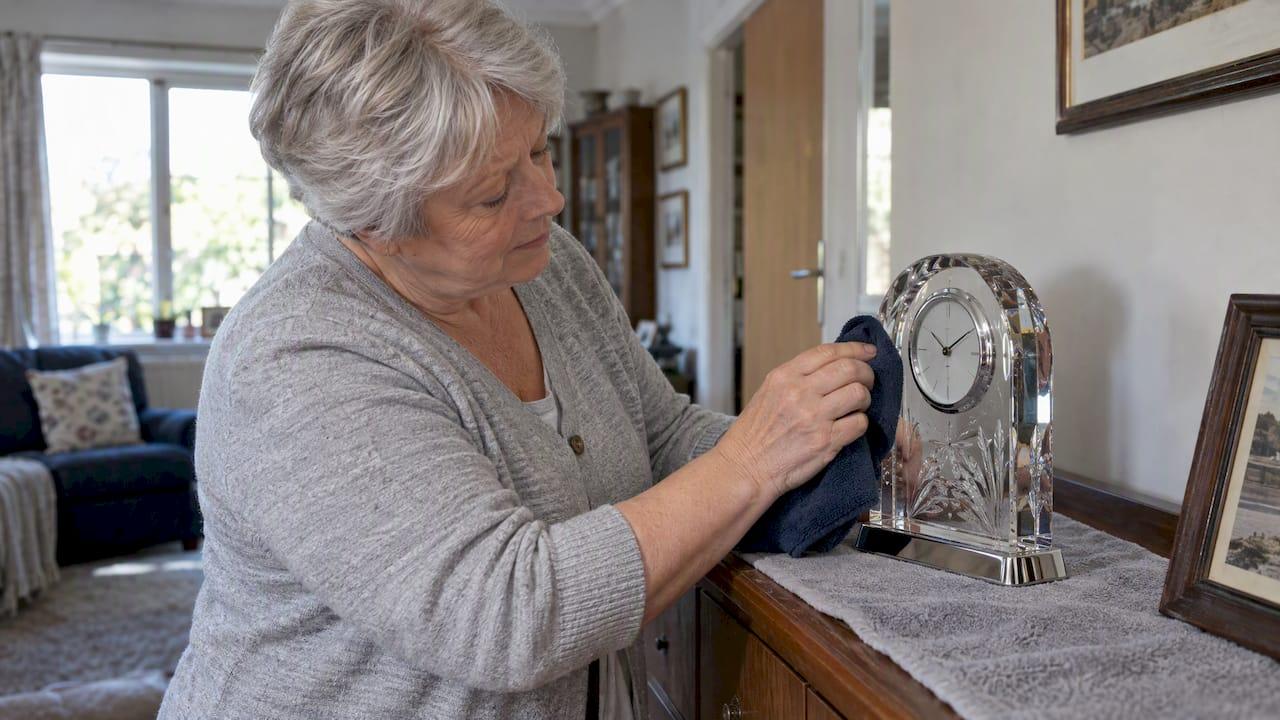
To clean an engraved crystal clock, start dry. Set it on a padded surface, dust it with a soft microfiber cloth, and spot-clean only if you need to, using a barely damp lint-free cloth or cotton swab. Wipe dry right away and keep liquid away from the seams, the battery compartment and the movement. Skip glass cleaner, vinegar, abrasive pads and toothpaste. A retirement clock is a keepsake, so the goal is a gentle tidy-up, not a showroom shine.
✦ Featured From Our Shop ✦
Handcrafted & laser engraved in Georgia, just for you
We engrave personalized gifts for a living, and people often ask us how to look after them once the party is over. This guide walks through the whole routine, plus the cases where the safest move is to put the cloth down.
TL;DR
- Dust first with dry microfiber or a very soft brush. Most clocks need nothing more.
- For fingerprints or grime, use distilled water on a lint-free cloth or swab, wrung nearly dry, then dry the glass immediately.
- Never use ammonia glass cleaner, vinegar, bleach, toothpaste, powdered cleanser or a dishwasher.
- Do not wash a clock with cracks, lifting decoration, or a powdery or sticky surface. Dust it gently and ask a professional.
- Cleaning the outside will not fix a clock that runs poorly. That is a job for a clockmaker.
Table of Contents
- Why a crystal clock needs a gentler touch than your kitchen glasses
- Before you touch it: a two-minute inspection
- The safe cleaning routine, step by step
- What not to use
- Silver-colored bezels and trim
- When to stop and call a professional
- Our perspective: keep the engraving, skip the shine
- Where to display it so it needs less cleaning
- A simple care schedule
- Giving a retirement clock? Choose a piece that fits the person
- A few more habits that protect a keepsake
- FAQ
- Sources
Why a crystal clock needs a gentler touch than your kitchen glasses
A retirement clock sits at an awkward intersection. It is glass, it is engraved, it often has a metal bezel or base, and it has a working movement tucked inside. Each of those parts has its own way of getting damaged.
Conservators, the people who care for glass in museums, follow one principle: use the least aggressive method that works. The Corning Museum of Glass conservation lab washes sound glass in a large plastic sink, because plastic is softer than metal or stone and helps protect the pieces from bumps. That tells you something useful. The biggest risk is usually not the wipe. It is the knock.
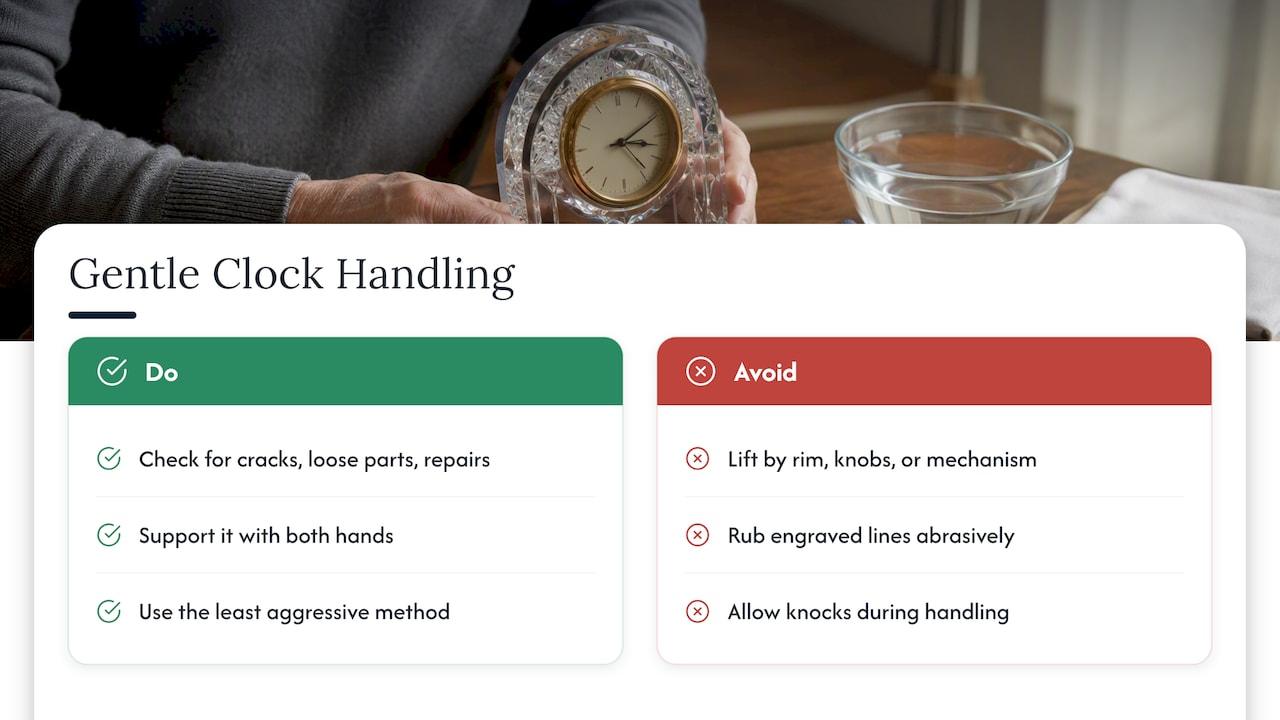
National Park Service guidance on glass objects makes the same point about handling: check for hairline cracks, loose parts and unstable repairs before you clean, and support the object with both hands. Never lift a clock by its rim, knobs, decorative elements or mechanism.
That is also why an engraved gift deserves extra respect. The engraved lines are recessed, so they catch dust, and they are exactly where abrasive rubbing does the most harm.
Before you touch it: a two-minute inspection
Put the clock on a table covered with a folded towel or a soft mat, not on the edge of a counter. Then look it over in good light.
Check for:
- Hairline cracks in the crystal, especially near corners and the base.
- Chips along the edges.
- Loose pieces, such as a bezel, a stand or a mounted plate.
- Engraving or decoration that looks lifted, flaky or different from the rest.
- A surface that feels powdery, sticky or crackled.
- Signs of a past repair, like glue lines.
Museum guidance from the Western Australian Museum’s collections manual says to clean glass only when it is in sound condition, and not to brush or wet glass with poorly adhering paint or surface weathering. Most modern engraved crystal gifts will pass this check easily. If yours does not, jump to the section on when to stop.
The safe cleaning routine, step by step
What you need
A soft, clean microfiber cloth. A very soft brush, like a clean makeup brush or a soft paintbrush. Cotton swabs. A lint-free cloth. A small cup of distilled water. A towel for padding. That is the whole kit.
Step 1: Dry dust everything
Museum guidance recommends dry cleaning first. Use the brush to coax dust out of the engraved lines, working gently in one direction, then go over the flat surfaces with the microfiber. Do not press. If the clock is going back on a shelf and there is no visible grime, you can stop here.
Step 2: Spot-clean fingerprints and film
If there are smudges, put a small amount of distilled water on a lint-free cloth or cotton swab. It should be damp, not wet. Wipe the smooth crystal surfaces in light passes. Distilled water leaves fewer mineral spots than tap water, which matters on clear glass where spots show.
For the engraving itself, use a barely damp swab and trace along the lines rather than scrubbing across them. The point is to lift the dust, not to flood the recesses. Moisture that sits in engraved lines can hold onto dirt.
Step 3: Dry right away
Follow with a dry microfiber cloth immediately. Water left to dry on its own is what leaves streaks and spots. Keep the cloth away from the clock face, seams, any openings and the battery compartment.
Step 4: If it is still grimy
Sometimes a clock has been handled for years, or lived in a kitchen or a smoker’s home. Conservation literature favors water first and, only if necessary, a dilute non-ionic detergent without perfume or ammonia, followed by thorough rinsing and prompt drying. For a clock, the practical version is this:
- Put one or two drops of mild, fragrance-free dish soap in a cup of distilled water.
- Dampen a cotton swab or cloth and wring it out well.
- Wipe the dirty area only, never the whole clock at once.
- Go over it again with a swab dampened in plain distilled water to remove soap residue.
- Dry with microfiber right away.
This is a judgment call, not a requirement. If you are unsure, the dry method is always the safer one.
What not to use
Here is the list we would tape inside a cupboard door.
| Product | Why to skip it |
|---|---|
| Household glass cleaner with ammonia | The National Park Service advises against acidic, caustic and abrasive cleaners on glass, and common ammonia glass cleaners should not be used |
| Vinegar, bleach | Acidic or caustic, and liquid can creep into seams |
| Toothpaste, powdered cleanser, scouring pads | Abrasive, and they scratch the polished surface and wear down engraved edges |
| Magic erasers | They are a mild abrasive. Forum tips for cleaning metal clock cases are not written for engraved glass |
| Spray bottles aimed at the clock | Overspray travels into the case |
| Dishwasher | Heat, knocks and moisture are all hazards |
| Soaking or immersing | Water and movements do not mix |
The common thread: a clock is not a drinking glass. It has parts that cannot get wet.
Silver-colored bezels and trim
Many retirement clocks have a metal base or frame. Do not assume it is solid silver. Canadian Conservation Institute guidance on caring for silver starts by working out whether a piece is solid or just plated, because plating is thin.
For light dullness, test in a hidden spot first, then use cotton lightly moistened with a dilute detergent solution. Conservation guidance in the NPS Conserve O Gram series separates light surface cleaning from tarnish removal and warns that polishing and chemical dips can remove surface metal. Silver dips and aggressive polish are a bad idea on plated, gilded, engraved or embossed trim, and the same goes for tarnish-removal cloths that are loaded with abrasive. Also, hydrogen peroxide, rubbing alcohol and dish soap are not universally safe on metal finishes, whatever a quick search suggests. If the trim is badly tarnished and the clock matters to you, ask a professional before you try anything.
Keep metal polish off the crystal too. It smears into engraving and is hard to remove.
When to stop and call a professional
Sometimes the right answer is to do less. Museum guidance says to avoid washing when repairs, unstable surfaces or deterioration are present. Do not wash or immerse your clock if:
- The crystal has cracks or chips.
- The engraving or decoration is lifting.
- The surface is powdery, sticky, crackled or weathered.
- The piece has been repaired before.
- Stains look like they might spread.
In those cases, limit yourself to gentle dry dusting and speak with a conservator or a clock professional.
The clock itself is a different job
Wiping the outside of a clock does not clean the inside. The Canadian Conservation Institute’s guide to clocks and watches explains that a clock works properly only when its parts are clean and correctly lubricated, and it recommends a professional evaluation when condition is uncertain. Never spray cleaner, water, alcohol or lubricant through openings.
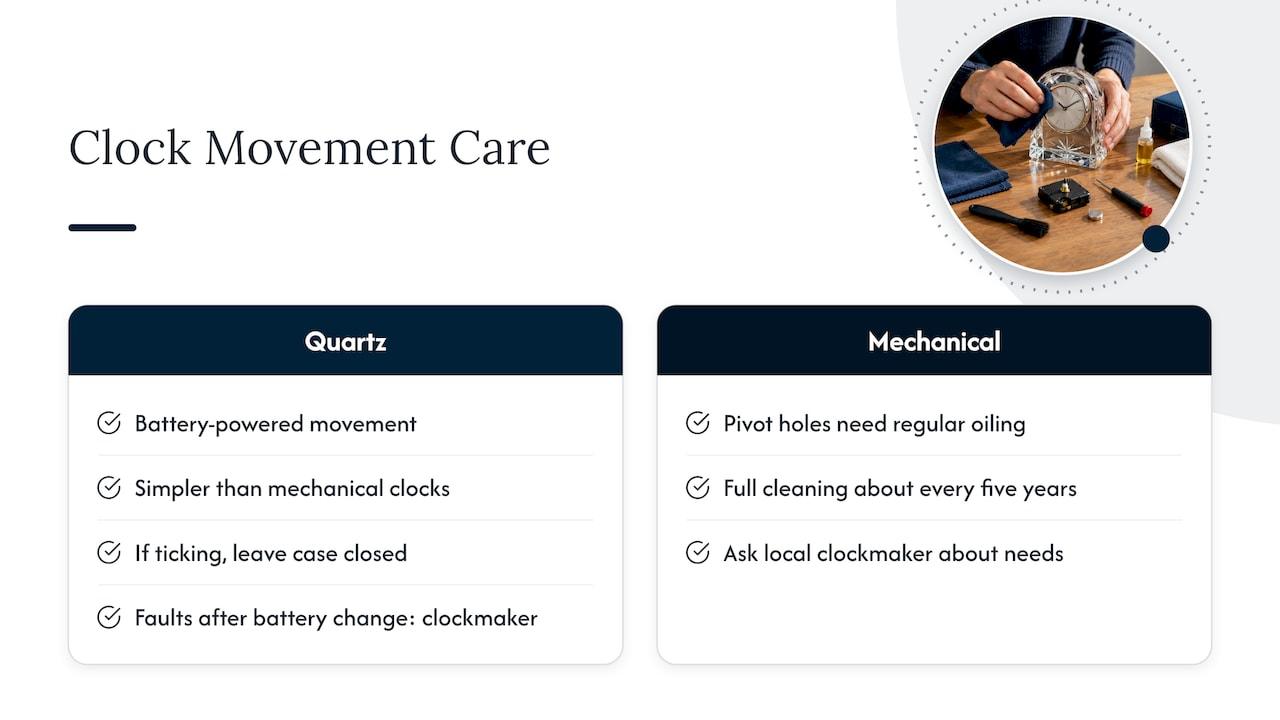
Most modern retirement clocks use a battery-powered quartz movement, which is simpler than an antique mechanical one. If yours ticks along happily, leave the case closed. If it stops, runs slow, or the hands behave oddly after you change the battery, take it to a clockmaker. Cleaning the crystal improves how it looks. It will not fix a worn or dry movement.
If you own a mechanical clock, the maintenance picture is bigger. One clock repair shop explains that the pivot holes need regular oiling and that the clock needs a complete disassembly and cleaning about every five years. That is the shop’s own estimate, so treat it as a rule of thumb and ask a local clockmaker what your clock needs. For general background on assessing a clock and deciding whether to run it, Connecting to Collections Care has a helpful overview.
Our perspective: keep the engraving, skip the shine
We laser-engrave wood and metal gifts, and we also offer personalized crystal pieces on our site. When customers ask how to care for a retirement gift, our answer is always more modest than they expect.
A retirement clock tells a story. Someone spent years in a job, and a team chose words to say thank you. Those words are in the engraving. The point of care is to keep them readable and keep the piece in one unbroken whole, not to make it look factory-new. A bit of soft dusting every few weeks does more for a keepsake than a once-a-year deep clean with the wrong product.
The other thing we tell people is to treat handling as the real risk. Pick the clock up with both hands, set it on something soft, and keep it out of high-traffic spots like a crowded bookshelf edge. Most of the damaged gifts we hear about were knocked, not neglected.
And if you are giving the clock rather than owning it, add a little note about care. It is a thoughtful extra, and it helps the retiree hold onto the gift for decades.
— Gary
Where to display it so it needs less cleaning
The University of Illinois Preservation Self-Assessment Program notes that dust collects in engraved recesses and can hold moisture or pollutants that speed deterioration. So the best cleaning strategy is to stop dust arriving in the first place.
- Closed or covered spots. A glass-front cabinet or a shelf with a door cuts down on dust, and on handling.
- Away from the kitchen and smoke. Grease and smoke leave a film that is harder to remove than dust.
- Out of direct sun. Strong sunlight is hard on the piece and on any metal trim.
- Away from humidity. Bathrooms and damp basements are poor homes for a clock.
- Stable and low-traffic. A sturdy shelf at chest height beats a crowded mantel.
With a good spot, you may find a dry wipe a few times a year is all it needs.
A simple care schedule
| How often | What to do |
|---|---|
| Every few weeks | Dry dust with microfiber or a soft brush |
| Every few months | Spot-clean fingerprints with distilled water on a nearly dry cloth, then buff dry |
| Yearly | Inspect for cracks, loose parts or lifting decoration, and check the battery |
| When something seems off | Stop and ask a clockmaker or conservator |
Giving a retirement clock? Choose a piece that fits the person
If you are reading this before the retirement party rather than after, you may still be choosing the gift. We engrave personalized crystal pieces to order, and a clock is not the only option. A desk-friendly piece can be a lasting alternative if the retiree already has a clock on every wall. Our Crystal Cube Paperweight and Crystal Rectangle Award are two examples, and our Crystal Diamond Award and Personalized Crystal Globe Award give you more shapes to browse. You enter the personalization right on the product page.
Want something more personal than crystal? Our Custom Gift Creation service is the place to talk through an idea, and you can browse our full range at Signature Laser Designs. Our wood and metal gifts are made to order in our Georgia shop.
If you also own engraved stainless steel kitchenware, such as a pie server, our guide to keeping a laser-etched pie server’s engraving crisp covers that, since metal and crystal need different care.
A few more habits that protect a keepsake
Wash your hands first. Skin oils leave prints that then need cleaning. Clean, dry hands mean fewer wipes.
Use one cloth for one job. Keep a microfiber just for the clock. A cloth that has touched furniture polish or kitchen spray can leave residue.
Wash the cloth gently. Launder microfiber without fabric softener, which leaves a coating that smears on glass.
Work over a soft surface. If it slips, a towel is much kinder than a countertop.
Skip the shortcuts. Compressed air can help blow dust from a case, but never aim it into the movement openings of a clock you are not sure about, and do not use it close to loose parts.
These small habits matter more than any product.
FAQ
Can I use glass cleaner on an engraved crystal clock?
No. Common glass cleaners contain ammonia, and National Park Service guidance says acidic, caustic and abrasive cleaners can damage glass. Spray can also run into the case. Distilled water on a nearly dry lint-free cloth does the job for most smudges.
Can I clean the inside of the clock myself?
We would not. Cleaning a movement is not a surface-care task, and a thorough cleaning generally means taking it apart so each part can be inspected. If the clock stops or runs poorly, have a qualified clockmaker look at it, and never spray anything through openings in the case.
Is it safe to put the clock in the dishwasher or soak it?
No. Heat, bumps and moisture are all risks, and water does not belong near the movement or battery compartment. Hand-wipe only, with a cloth that is damp rather than wet.
How do I clean the tarnished silver-colored base?
Test a hidden spot first, then use cotton lightly moistened with a dilute detergent solution on light dullness only. Avoid silver dips and strong polish, especially on plated, engraved or embossed trim, since tarnish removal takes away some metal. For heavy tarnish, see a professional before trying anything stronger.
What if the engraving looks like it is flaking or lifting?
Stop wet cleaning. Conservation guidance advises against washing glass with unstable or poorly adhering surfaces, so limit yourself to gentle dry dusting and consult a conservator or clock professional.
Sources
- Appendix P: Curatorial Care of Ceramic, Glass, and Stone Objects (National Park Service)
- Glass treatments (Western Australian Museum collections manual)
- Conservation Laboratory (Corning Museum of Glass)
- Basic care: Clocks and watches (Canadian Conservation Institute)
- Care of silver (Canadian Conservation Institute Note 9/7)
- Conserve O Gram on cleaning metal surfaces (National Park Service)
- Glass (Preservation Self-Assessment Program, University of Illinois)
- Tick Tock: Care for Your Clock (Connecting to Collections Care)
- The High Cost of Owning a Clock (Blue Paper Technology)
Recommended
- Engraved Crystal Golf Ball Clock | Golf Award & Retirement Gift
- Personalized Crystal Gift | Engraved
- Crystal Rectangle Award | Personalized & Engraved
- Personalized Desk Clock | Engraved Retirement & Service Gift