Commercial Equipment Identification Plates Manufacturer Guide
Hire a U.S. custom laser-engraving manufacturer that offers anodized-aluminum and stainless-steel data plates with sub-surface marking and variable-data capability. That single decision separates plates that last the life of your equipment from labels that fade, peel, or fail inspection. To get an accurate quote fast, prepare and send:
✦ Featured From Our Shop ✦
Handcrafted & laser engraved in Georgia, just for you
- A tagged spreadsheet (CSV or Excel) with one row per plate: dimensions, material choice, quantity, all variable data fields (serial numbers, model numbers, barcodes), and mounting method
- Any artwork files in vector format (AI, EPS, or SVG)
- A note on your compliance requirements (UL, MIL-SPEC, ISO, FDA)
Once that file is ready, request a PDF proof and a lead-time estimate before any production begins.
Table of Contents
- What does a commercial equipment identification plate actually do?
- Which material and marking method give you the best durability?
- What data and design elements belong on every plate?
- How do plate size, thickness, and mounting affect your order?
- What does production actually cost, and how do you save?
- How do you choose the right manufacturer?
- Real-world use cases: matching specs to situations
- Key Takeaways
- How Signaturelaserdesigns approaches equipment plates
- Ready to order custom equipment plates from Signaturelaserdesigns?
- Useful sources and further reading
What does a commercial equipment identification plate actually do?
Equipment nameplates, data plates, and rating plates are rigid metal or durable plastic panels permanently marked with the information a machine needs to carry for its entire service life. That includes model number, serial number, electrical ratings, safety warnings, and asset-tracking codes. They are not decorative; they are functional records attached to the equipment itself.
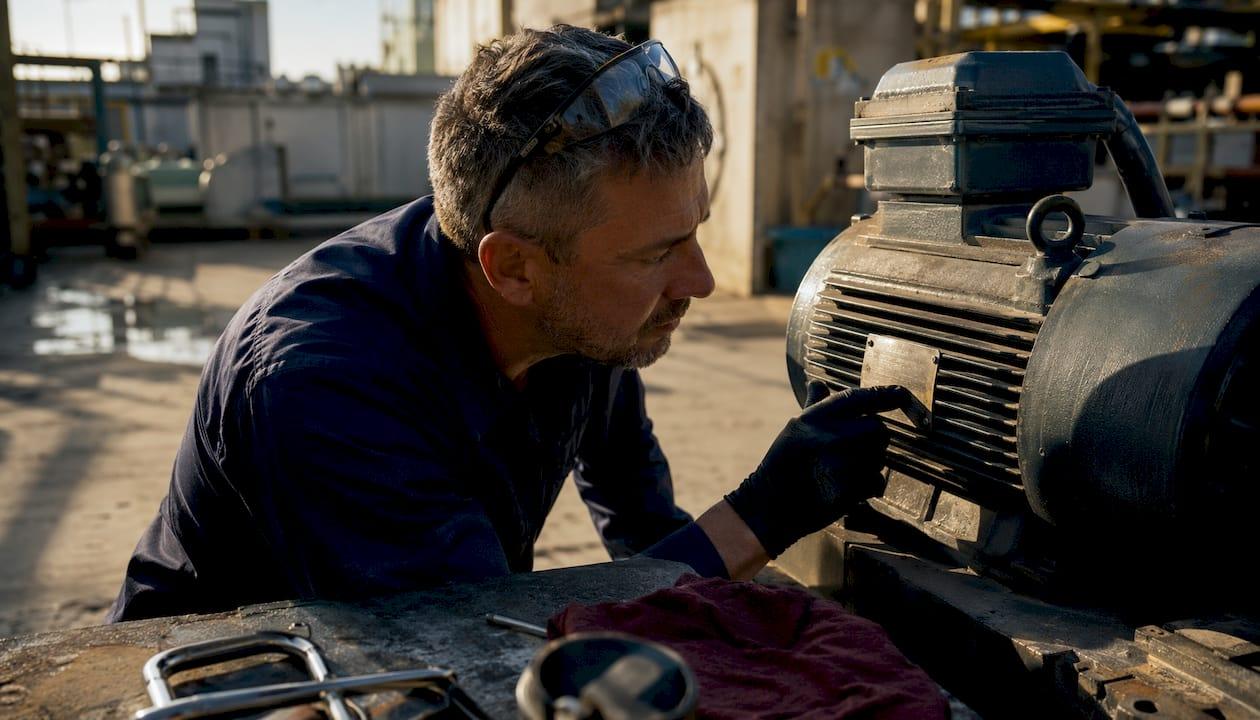
Common applications include OEM rating plates on motors and compressors, safety and warning plates on control panels, serialized asset tags for distributed equipment fleets, and compliance plates required by UL, CSA, or FDA regulations. The rule of thumb for choosing a plate over a printed label is straightforward: if the surface will face UV exposure, chemicals, abrasion, washdown cycles, or needs to stay legible for the life of the asset, a durable plate is the right call.
Which material and marking method give you the best durability?
Anodized aluminum is the default choice for most industrial identification plates. It resists salt spray, chemicals, abrasion, and UV, making it the right starting point for the majority of applications. Stainless steel steps in for high-heat, marine, or caustic chemical environments where aluminum’s limits show. Brass works beautifully for decorative or premium client-facing plates, though it will tarnish over time and is not suited for hard industrial duty. Plastics and Metalphoto (photographic anodized aluminum) round out the options when photographic-grade graphics or extreme outdoor durability are needed.
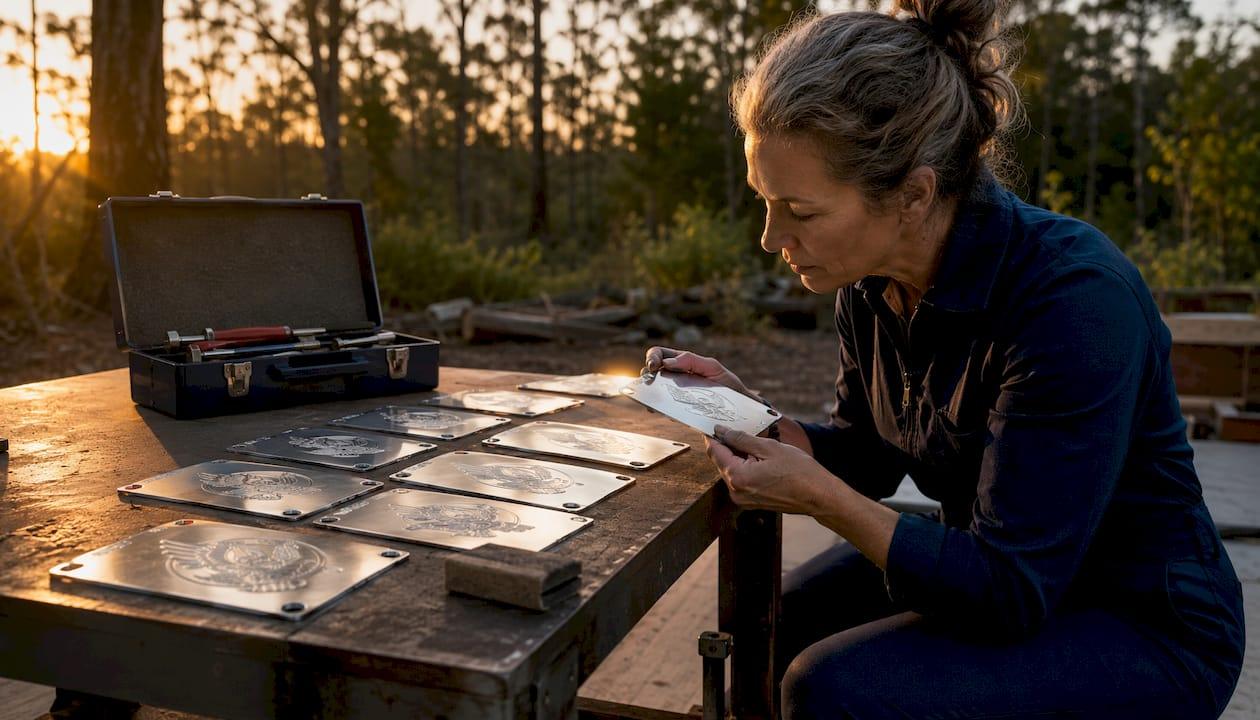
Marking method matters just as much as material. Sub-surface processes like chemical etching, anodizing, and Metalphoto seal the mark into the material itself, so abrasion, solvents, and UV cannot degrade it the way they attack surface printing. Laser engraving removes material at depth and is excellent for barcodes, QR codes, and variable serial data. Screen and digital printing sit on the surface and are best reserved for short-service or indoor-only applications.
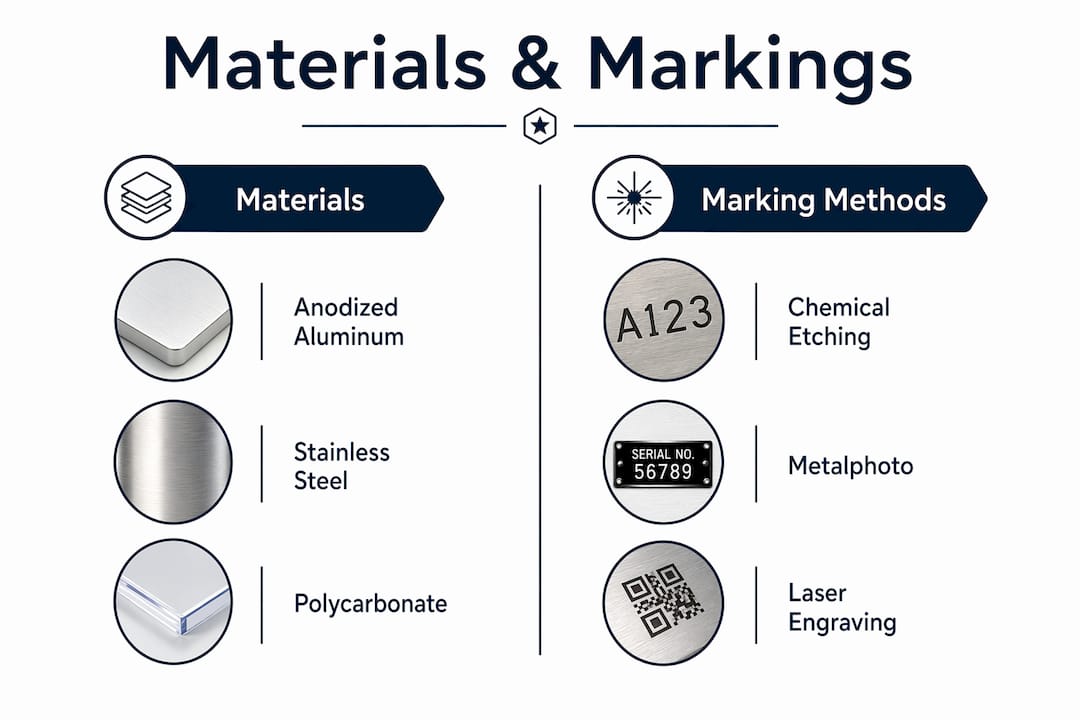
| Material | Marking Method | Durability / Environment | Typical Cost Drivers | Lead Time / MOQ | Best For |
|---|---|---|---|---|---|
| Anodized aluminum | Chemical etch / anodize / laser | Excellent: UV, chemicals, abrasion | Qty, color fills, variable data | Standard runs; low MOQ | Asset tags, OEM plates, most industrial |
| Stainless steel (304/316) | Chemical etch / laser engraving | Superior: high heat, marine, caustic | Material cost, thickness, finishing | 7–10 business days typical | Marine, food processing, high-heat |
| Brass | Chemical etch / laser engraving | Moderate: decorative, will tarnish | Material cost, color fill | Short runs available | Premium branded plates, decorative |
| Metalphoto (anodized Al) | Photographic sub-surface imaging | Outstanding: outdoor, photographic detail | Setup, imaging process | Longer lead; higher setup | Aerospace, military, precision graphics |
| Polycarbonate / polyester | Screen print / digital print | Good: indoor, light chemical | Low material cost | Fast; very low MOQ | Control panel overlays, indoor labels |
Pro Tip: Match your marking depth and process to the expected abrasion and chemical exposure before you choose a material. Defaulting to the cheapest visible option often means reprinting or replacing plates within a few years, which costs far more than getting the spec right the first time. For environments with aggressive chemical exposure, 316 stainless with chemical etching is worth the premium.
What data and design elements belong on every plate?
A well-designed plate carries everything a technician, inspector, or asset manager needs without crowding the surface. Core fields to include:
- Manufacturer name and logo
- Model number and serial number
- Electrical ratings (voltage, amperage, phase, Hz) where applicable
- Date of manufacture or production lot
- Part number or internal asset number
- Required safety symbols and compliance marks (UL, CSA, CE, FDA)
- QR code, barcode, or DataMatrix for asset tracking and maintenance workflows
For scannable codes, specify the print resolution and quiet zone in your proof request, and ask the manufacturer to test-scan every code before shipping. A barcode that cannot be read on the production floor defeats the purpose entirely.
Legibility guidelines matter too. Minimum font size for a plate read at arm’s length is generally 6–8 pt for secondary data and 10–12 pt for primary identifiers. High-contrast filled etches (dark fill in a recessed mark) outperform no-fill etches in low-light environments.
Pro Tip: Add a dedicated variable-data column in your CSV tag list for every field that changes per plate (serial number, asset ID, QR code URL). That single step lets the manufacturer batch-program all plates without per-tag drawings, which cuts setup fees and speeds production.
How do plate size, thickness, and mounting affect your order?
Plate thickness typically ranges from very thin foil labels up to heavy-duty structural plates, with most industrial nameplates falling in the common thin to medium thickness range. Thicker plates cost more per unit but handle mechanical stress and vibration better. Size directly affects the readable area and the per-unit material cost, so standardizing on a common plate size across a product family saves money at scale.
Mounting options break down into three categories:
- Adhesive backing: Fast to install on smooth, flat, low-vibration surfaces. Not reliable on rough, curved, or high-vibration equipment.
- Rivets, screws, or studs: Required for heavy-duty or safety-critical equipment. Include hole diameter, placement, and countersink specs in your tag list to avoid back-and-forth revisions.
- Tamper-evident fasteners: Used when the plate must show visible evidence of removal, common in regulated industries.
For outdoor equipment or anything subject to vibration, mechanical fastening is the right call. Adhesive alone will not hold through years of thermal cycling and vibration. Include hole locations in your tag list from the start.
What does production actually cost, and how do you save?
The production path runs: quoting → PDF proof → tooling or programming → sample approval → batch production → inspection → shipping. Each step has a cost lever.
Major cost drivers include:
- Material choice: Stainless and Metalphoto cost more than anodized aluminum per unit
- Quantity: Per-unit price drops significantly with volume; uploading a tag list rather than individual drawings reduces setup fees
- Design complexity: Multiple colors, color fills, and intricate graphics add time and cost
- Variable-data programming: More unique fields per plate increase setup time
- Finishing: Brushed, mirror, or matte finishes add a step and a cost
Fast-turn small runs typically carry a rush premium. Standard production for most industrial nameplates runs about one to two weeks after proof approval; larger batches or complex tooling can extend that.
Pro Tip: Engage the manufacturer during the design phase, not after. Consolidating plate sizes, standardizing hole patterns, and providing a complete CSV tag list up front avoids tooling rework and redesign charges that can easily exceed the plate cost itself.
How do you choose the right manufacturer?
A reliable equipment nameplate supplier will ask for your tag list before quoting, not after. Here is a practical checklist:
- Request material specs and alloy grades (e.g., 316 stainless, 5052 aluminum) in writing
- Ask for sample photos or production proofs of comparable plates
- Confirm minimum order quantity and per-unit pricing at your target volume
- Get a full pricing breakdown: setup fees, tooling, per-unit cost, finishing, and shipping
- Ask whether they offer sub-surface marking (anodize, chemical etch, or Metalphoto)
- Confirm they can laser-etch barcodes and QR codes and test-scan them before shipping
- Ask which standards they meet: UL-969, MIL-SPEC, ISO 9001:2015
- Request a clear proofing policy: PDF proof minimum, physical sample option for large runs
Prefer suppliers who treat your CSV tag list as the starting point for quoting. That practice, recommended by leading nameplate manufacturers, signals they have variable-data tooling and batch-processing capability built into their workflow.
Real-world use cases: matching specs to situations
Three scenarios show how material, marking, and mounting choices come together:
- Outdoor pump on a saltwater dock: 316 stainless steel plate, laser engraving or deep chemical etch, mechanical studs or rivets. Adhesive will not survive the combination of salt air, moisture, and vibration. The corrosion resistance of 316 stainless is the deciding factor here.
- Control panel inside a factory: Anodized aluminum, chemical etch or Metalphoto for photographic-quality overlays, adhesive or rivets depending on panel construction. Sub-surface marking keeps the legend legible through years of cleaning solvents and operator contact.
- Premium branded equipment for a client-facing product: Brass or anodized aluminum with color fill and a laser-engraved logo. The finish elevates the perceived quality of the product and carries the brand through the asset’s life.
In every case, sub-surface marking outperforms surface printing for long-term legibility. A printed label on a saltwater dock pump may last two seasons; a chemically etched stainless plate lasts the life of the pump.
Key Takeaways
Custom laser-engraved equipment plates last the life of your asset when you match material to environment, specify sub-surface marking, and supply a complete CSV tag list before quoting.
| Point | Details |
|---|---|
| Supply a CSV tag list | One row per plate with dimensions, material, qty, variable data, and mounting method speeds quoting and cuts setup fees. |
| Match material to environment | Anodized aluminum for most uses; 316 stainless for marine or high-heat; brass for decorative premium plates. |
| Insist on sub-surface marking | Chemical etch, anodize, or laser engraving outlasts surface printing in UV, chemical, and abrasion-heavy environments. |
| Confirm mounting method early | Mechanical fasteners (rivets, screws, studs) are required for vibration or outdoor safety-critical equipment. |
| Signaturelaserdesigns | Offers custom laser-engraved equipment plates with PDF proofs, variable-data handling, and transparent pricing for B2B and B2C orders. |
How Signaturelaserdesigns approaches equipment plates
At Signaturelaserdesigns, we handle both the personalized gift side and the professional marking side of laser engraving, and the process is the same either way: we start with your specs, send a PDF proof, and do not begin production until you approve it. For equipment plates specifically, our team works with metal substrates including aluminum and brass, and we support variable data so each plate in a batch can carry a unique serial number or barcode.
Ready to order custom equipment plates from Signaturelaserdesigns?
When you need durable, scan-ready equipment plates with transparent pricing and a clear proofing process, Signaturelaserdesigns is ready to help. We handle industrial laser engraving for both small custom runs and larger B2B batches, with variable-data capability so every plate in your order carries the right serial number, barcode, or QR code.
Upload your CSV tag list or share your plate dimensions and material requirements, and we will send back a PDF proof with a lead-time estimate. You can also request a custom quote directly through our services page or order through our Etsy storefront (on Etsy) for smaller runs. Sample proofs are available on request.
Useful sources and further reading
Before finalizing your order, these sources are worth reviewing for material specs, test methods, and compliance standards:
- Metal Marker Manufacturing — Equipment Nameplates: Overview of metal nameplate types including barcode, UID, and asset tags; useful for understanding scope and application categories
- Express Corp — Industrial Nameplates and Data Plates: ISO 9001:2015 certified U.S. manufacturer with detailed material and technical spec guidance
- SITAPRESS — Custom Stainless Steel Nameplates: Deep chemical etching specs for AISI 304 and 316 stainless, including thickness ranges and lead-time benchmarks
- Hallmark Nameplate — Industrial Nameplates and ID Tags: Comprehensive overview of Metalphoto, barcode, UID, and MIL-SPEC applications
- MyAssetTag — Equipment ID Tags: Practical guidance on scannable code integration and asset-tracking workflows
- MPC — Custom Equipment Nameplates: Metalphoto process detail and sub-surface marking standards for heavy industry
Recommended