Professional Office Name Plate Sizes: The Complete Guide
The standard size for a professional office name plate depends on where it goes. For desks, common professional name plate dimensions include sizes around 8×2 and 10×2 inches, with a typical height near 2 inches. Door and room signs commonly use sizes such as 8×2 or around 12×4 inches. Departmental or facility signage often includes sizes near 12×4 inches, with larger dimensions used for entrances and organization-level displays.
✦ Featured From Our Shop ✦
Handcrafted & laser engraved in Georgia, just for you
- Desk name plates: 8×2, 10×2, or 12×2.5 inches
- Door/room signs: 8×2 or 12×4 inches
- Departmental signs: 12×4 inches
- Entrance/facility signs: 18×6 inches or larger
Signaturelaserdesigns handles all of these sizes with precision laser engraving on wood, metal, acrylic, and more. If your sign will be permanently mounted on a wall or door, ADA (Americans with Disabilities Act) accessibility rules may also apply to your order.
The right size isn’t just about aesthetics. It’s about legibility at the distance your visitors will actually read from, the number of text lines you need, and whether your sign falls under ADA compliance requirements.
Table of Contents
- What are the standard office name plate sizes at a glance?
- How do you pick the right size for your specific placement?
- What design and layout rules affect the size you should order?
- How does material and thickness affect your name plate size choice?
- When does ADA apply to your office name plate?
- What should you expect when ordering and budgeting for custom name plates?
- Key Takeaways
- Why getting the size right matters more than most buyers realize
- Ready to order your custom laser-engraved name plate?
- Useful sources and next steps
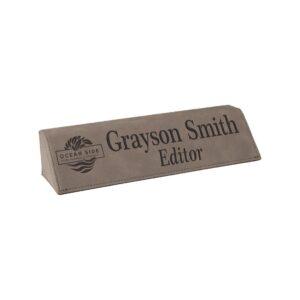
What are the standard office name plate sizes at a glance?
Desk nameplate dimensions typically range around 2 inches in height and from about 8 to 12 inches in width. Here’s how that breaks down by use case:
| Use Case | Typical Size | When to Choose It | Visibility Range |
|---|---|---|---|
| Compact desk | Smaller size, typically 8×2 inches | Tight desk space, single name line | 2–4 ft |
| Standard desk | 8×2 or 10×2 in | Most office desks, name + title | 3–6 ft |
| Wide desk | 12×2.5 in for long names or multiple lines | Long names, titles, or two lines | 4–8 ft |
| Door/room sign | 8×2 or 12×4 in | Office doors, conference rooms | 5–10 ft |
| Departmental sign | 12×4 in | Department entrances, shared spaces | 5–10 ft |
| Entrance/facility | 18×6 in or larger | Lobbies, building entrances, branding | hallway or entering a lobby |
A few quick notes on choosing between sizes:
- Plates around 10×2 inches are among the most versatile desk options. They fit most standard name holders and gives you room for a name plus a short title.
- The 12×4 inch format works for both door signs and smaller departmental labels, making it a popular choice for bulk office orders.
- The 6×2 inch plate is situational. It’s fine for a single short name but gets cramped fast with a title or department line.
How do you pick the right size for your specific placement?
Viewing distance is the single biggest factor most buyers overlook. A plate that reads perfectly from 3 feet away may be completely illegible from across a hallway.

For desk plates, your visitor is typically 3–6 feet away. An 8×2 or 10×2 inch plate with a 14–18 pt font handles that distance well. If you need two lines (name plus title), the 10×2 or 12×2.5 inch format gives you the vertical and horizontal room to keep text readable without crowding.

For door and room signs, the reader is usually approaching from 5–10 feet. A 12×4 inch plate gives you enough height for two clear lines at 20–24 pt, plus breathing room above and below the text. An 8×2 door sign works for a single name, but it can feel undersized on a wide door frame.
For departmental or entrance signs, you’re designing for someone walking down a hallway or entering a lobby. The 12×4 inch format handles two to three lines at this scale, while 18×6 inches is the right call when you’re adding a logo, department name, and sub-text together.
One rule of thumb worth keeping: if your content requires more than two lines of text, go up a size. Cramming three lines onto an 8×2 plate forces the font down to a size that’s hard to read under typical office lighting.
Pro Tip: Print your intended layout at actual size on paper and tape it to the wall or desk at the planned mounting height. Step back to your expected viewing distance and check legibility before you finalize the order.
What design and layout rules affect the size you should order?
Good design on a name plate starts with margins. A plate that uses every inch of its surface looks crowded and unprofessional. Leave at least 0.25 inches of clear margin on all four sides, and 0.375 inches on wider plates.
Font choice can force a size change. Script and decorative fonts require larger point sizes to stay legible after engraving. If you love a script style, plan on a 12×2.5 or 12×4 inch plate rather than an 8×2.
For character counts, here’s a practical guide by plate width:
- 8-inch width: Fits roughly 20–24 characters per line at a readable size
- 10-inch width: Fits roughly 26–30 characters per line
- 12-inch width: Fits roughly 32–38 characters per line
Sans-serif fonts like Arial, Helvetica, or similar clean faces engrave with the sharpest contrast at small sizes. Thin serifs and hairline strokes can fill in or disappear depending on the material and engraving depth. For logo placement on wider plates, logos typically require 20–30% of horizontal space for a balanced layout on departmental or entrance signs.
A few dos and don’ts worth keeping in mind:
- Do use high-contrast combinations (dark engraving on light material, or light fill on dark metal)
- Do test your font at the actual engraved size, not just on screen
- Don’t use all-caps in a decorative script. It reduces legibility significantly after engraving.
- Don’t reduce font size to fit more text. Upsize the plate instead.
How does material and thickness affect your name plate size choice?
Material choice shapes both the look and the practical limits of your plate. Here’s a quick breakdown:
- Acrylic: Cost-effective, available in many colors, and great for standard desk plates. Thin sheets (1/8 inch) work well for 8×2 and 10×2 desk formats.
- Brass: Premium look with a warm gold tone. Ideal for executive desk plates and custom engraved brass tags. Works beautifully at 8×2 through 12×2.5 inches.
- Aluminum: Durable and lightweight. Anodized aluminum handles outdoor or high-traffic environments well. For industrial name plates, choose a thicker gauge when the plate will be wall-mounted at 12×4 or larger.
- Wood: Warm aesthetic, popular for boutique offices and personalized gifts. Works best at desk sizes; larger wood plates may warp without proper backing.
| Material | Best Size Range | Typical Thickness | Best Environment |
|---|---|---|---|
| Acrylic | 8×2 to 12×2.5 in | 1/8 in | Indoor desk/door |
| Brass | 8×2 to 12×2.5 in | 1/8 inch | Executive, gift |
| Aluminum | 8×2 to 18×6 in | thicker gauges | Facility, industrial |
| Wood | 8×2 to 10×2 in | 1/4–3/8 in | Indoor desk, decor |
Thin metals work fine for desk plates, but larger wall-mounted signs generally need thicker gauges to stay flat and hold mounting hardware securely.
When does ADA apply to your office name plate?
ADA rules apply to permanent room identification signs, not to small desk name plates. If your plate sits on a desk or is moved regularly, ADA does not govern it. If it’s permanently mounted on or beside a door to identify a room, it likely does.
The key test is permanence and function. A sign that permanently identifies a room (office number, conference room name, restroom) falls under ADA Title III requirements. A desk plate with an employee’s name does not.
When ADA applies, these are the requirements that directly affect your size and design choices:
- Character height: Raised characters must be between 5/8 inch and 2 inches tall.
- Contrast: Characters must contrast with the background (light on dark or dark on light).
- Tactile text and Braille: Permanent room signs require raised lettering and Grade 2 Braille.
- Mounting height: The sign must be mounted 60 inches above the floor to the centerline.
- Placement: ADA signs go on the latch side of the door, not on the door itself.
If you suspect your order falls under ADA, confirm the sign’s permanent placement, check with your building’s facilities manager, and request an ADA-compliant layout from Signaturelaserdesigns before finalizing dimensions.
What should you expect when ordering and budgeting for custom name plates?
Pricing for custom laser-engraved name plates is driven more by material and design complexity than by a small change in dimensions for low-quantity orders. Here’s how the main cost factors stack up:
| Pricing Factor | Impact on Cost |
|---|---|
| Material (acrylic vs. brass vs. aluminum) | High |
| Engraving detail and color fill | Medium–High |
| Plate size | Low–Medium |
| Quantity | Medium (bulk discounts apply) |
| Mounting hardware included | Low |
Sample tier ranges (general guidance, not fixed prices):
- Small desk plates (8×2, acrylic or wood): Entry-level pricing, fast turnaround, ideal for single orders or small office sets.
- Mid-size door plates (12×4, aluminum or brass): Mid-range pricing; allow extra lead time for color fill or logo work.
- Large departmental/entrance signs (18×6, metal): Higher material and setup costs; order a sample first for large runs.
Typical lead times range from a few business days for simple desk plates to one to two weeks for complex multi-piece orders with logos and color fill. For bulk orders, ordering a single sample plate before the full run is the best way to confirm legibility and finish.
Pro Tip: When submitting your quote request, include: desired size, material, number of text lines, exact text, logo file (vector preferred), mounting method, and quantity. A complete request gets you an accurate quote faster.
Some providers allow custom sizes by square-inch rules rather than fixed dimensions, which is useful when a nonstandard size fits a specific mounting constraint. When a plate exceeds typical nameplate area, it’s often priced and produced as a sign rather than a nameplate, which affects both lead time and cost.
Key Takeaways
The most common professional office name plate sizes are 8×2, 10×2, and 12×2.5 inches for desks, 12×4 inches for doors and departments, and 18×6 inches for entrances.
| Point | Details |
|---|---|
| Desk plate standard | 8×2, 10×2, and 12×2.5 inches are the most common professional desk applications. |
| Door and departmental sizes | 12×4 inches is standard for door signs and departmental labels; 18×6 for lobby and entrance displays. |
| Material and thickness | Match material to environment: acrylic for desks, aluminum or brass for wall-mounted and facility signs. |
| Design tip | Leave at least 0.25 inches of margin and choose a clean sans-serif font to keep engraving legible. |
| Signaturelaserdesigns | Handles all standard and custom sizes with transparent quotes and a sample-first policy for new orders. |
Why getting the size right matters more than most buyers realize
Most ordering mistakes I see come down to three things: text that’s too small to read at the actual viewing distance, plates that arrive without the mounting hardware needed to install them, and permanent door signs that needed ADA compliance but weren’t specified that way.
The fix for all three is the same: slow down before you order. Measure the space, count your text lines, confirm whether the sign is permanent, and request a proof. At Signaturelaserdesigns, we always recommend ordering a single sample plate when you’re trying a new size or material for the first time. It costs very little and saves a lot of frustration on a large run.
If you’re not sure whether your sign needs to meet ADA standards, ask your building’s facilities manager before you finalize the design. It’s a five-minute conversation that can prevent a costly reorder.
Ready to order your custom laser-engraved name plate?
Signaturelaserdesigns makes the ordering process straightforward: choose your size, pick your material, upload your artwork, review a digital proof, and approve. Every order gets a transparent quote upfront, so there are no surprises when it arrives.
We work with individuals, small businesses, and large facilities on everything from single executive desk plates to full departmental sign sets. Our industrial laser engraving services (on Etsy) cover metal, acrylic, wood, and more, with precision engraving that holds up in high-traffic environments. For corporate branding orders and larger runs, our company equipment branding page walks through the full process.
Ready to get started? Request a quote at signaturelaserdesigns.com and include your size, material, and text details. We’ll get back to you with a clear price and timeline.
Useful sources and next steps
| Resource | What It Covers |
|---|---|
| Desk nameplate dimensions guide | Standard desk plate sizes with drawings and measurement guidance |
| Office name board size reference | Departmental and entrance sign size standards |
| Standard desk name plate sizes | Cross-source confirmation of 8×2, 10×2, and 12×2.5 as common sizes |
| Industrial plates manufacturer guide | Material and mounting guidance for facility-grade name plates |
| Signaturelaserdesigns quote page | Request a custom quote, order a sample, or browse product options |
| Sign shop selection guide | Helpful if you’re also exploring local production options |
Next steps: Download a size template, request a digital proof, or order a single sample plate to confirm your dimensions before a full run. All three options are available through Signaturelaserdesigns.
Recommended