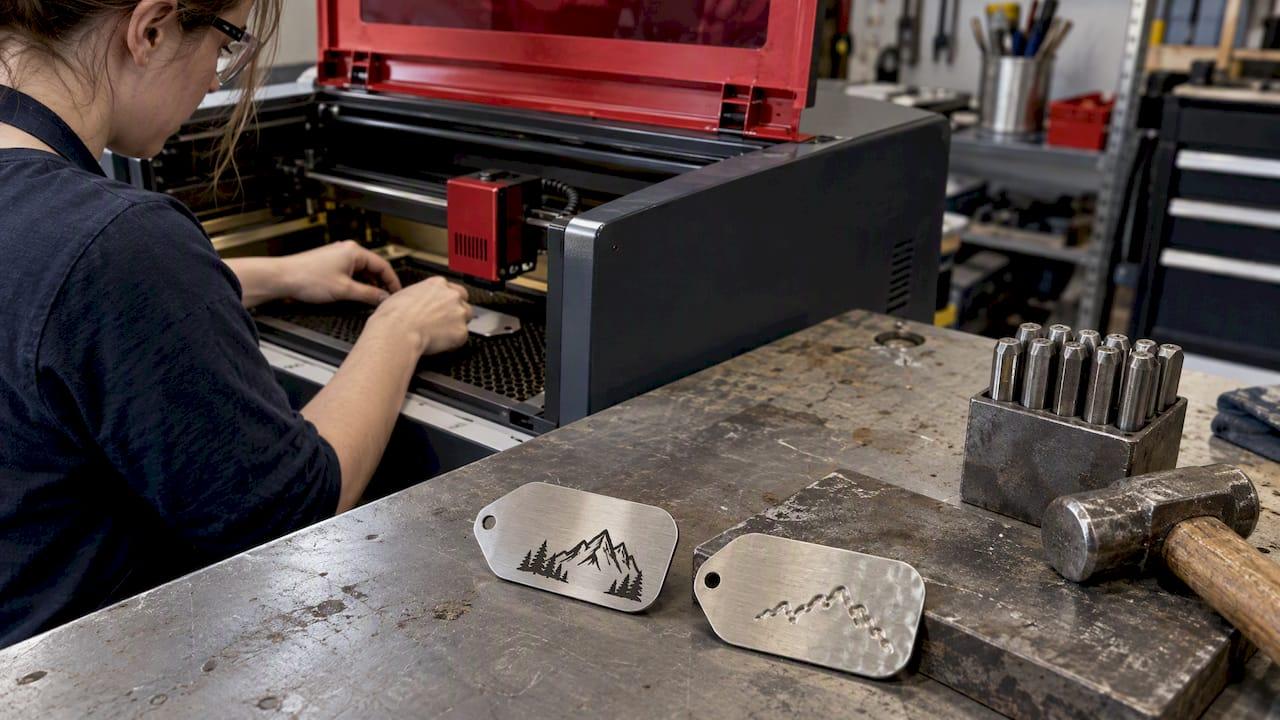
Laser Engraving vs. Metal Stamping: What It Means for Gifts
Can laser engraving replace traditional metal stamping? In a factory that turns out hundreds of thousands of identical parts, not entirely. For the gifts we make, the answer is mostly yes. A name, a date or a short message on a flask, money clip, keychain or kitchen tool is a job where laser engraving is usually the better fit. Stamping still has a place when you want a hand-hammered look.
✦ Featured From Our Shop ✦
Handcrafted & laser engraved in Georgia, just for you
We are a Georgia gift shop, not a production plant, so we write this for the person choosing a present. If you are comparing a hand-stamped piece with a laser-engraved one, this guide explains what actually differs and when each one makes sense.
TL;DR
- Stamping presses metal into shape or leaves a deep impression. Laser engraving removes or changes a thin layer of the surface with a beam of light.
- Large factories still rely on stamping for high-volume, identical parts, because the cost of making the die is spread over a huge run.
- For one-of-a-kind gifts, laser engraving wins on fine detail, custom wording, logos and artwork. Hand stamping wins on rustic, tactile character.
- A laser mark is smooth and crisp, so you see it more than you feel it. A stamped mark is something you can feel with a fingertip.
- Not every material is safe to laser. Reputable shops check the material first, and we do too.
Table of Contents
- The short answer: it depends on the job
- What each process actually does to metal
- Hand stamping vs. laser engraving for personalized gifts
- What about industrial tools?
- Metal gifts that suit laser engraving
- Choosing the wording and design
- Materials and safety: what a good shop checks
- Our perspective: why we chose the laser
- Ready to order a personalized metal or wood gift?
- FAQ
- Sources
The short answer: it depends on the job
The question usually comes from an industrial angle: can a laser take over the work a stamping press does? Engineers have a fairly consistent answer. One fabrication shop notes that stamping remains the benchmark for high-volume, uniform parts, because the cost of the tooling is spread across a very large number of pieces. The same source lists tooling at roughly $10,000 for stamping and none for laser, and a cycle time of 2,400 pieces an hour for stamping against 80 for laser. Those figures describe sheet-metal production, not gifts, but they explain the trade-off clearly.
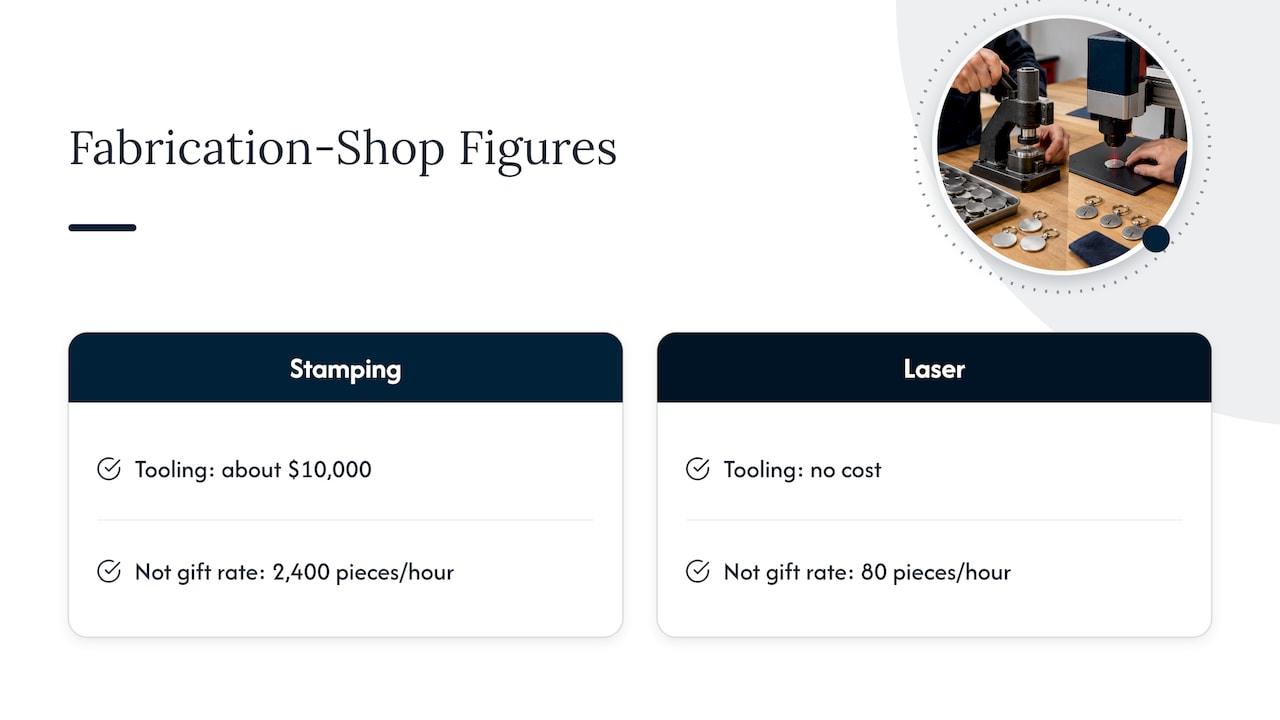
If you need a million identical parts, you build a die and stamp them. If you need one piece that says “Emma & Jack, June 14” you do not want to build anything. You want a design file and a laser.
That is the heart of it. The two processes are not really rivals. They solve different problems, and the right one depends on how many pieces you need and how personal each one is.
We focus on the personal end of that range, so the rest of this article looks at the question the way a gift shopper would.
What each process actually does to metal
It helps to picture what happens physically.
Stamping is a contact process. A hardened tool strikes the metal and displaces it. Think of a jeweler’s letter punches and a hammer, or a die pressed in a machine. One trade publication explains that stamping, peening and engraving all upset or displace material, and that these formed marks are the most permanent and survive harsh environments. The same article points out that stamping can deform thinner material or add stress to the part.
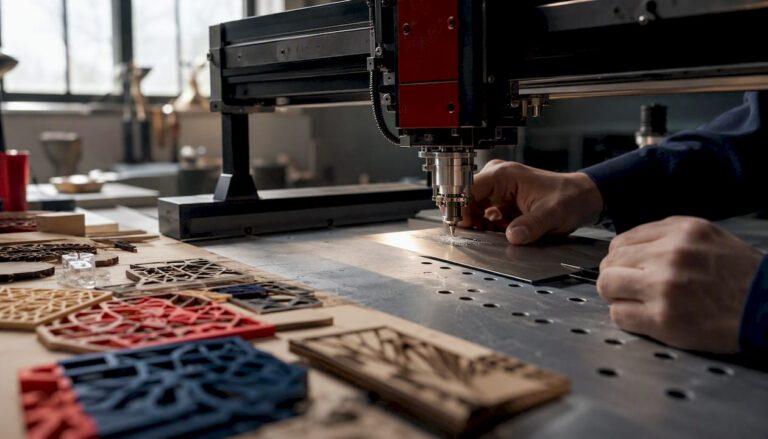
Laser engraving is a non-contact process. A focused beam heats the surface and either vaporizes a very thin layer or changes its color. Nothing touches the piece, so there is no hammer blow and little risk of bending a thin item.
Here is how that looks side by side for a gift buyer.
| Hand or die stamping | Laser engraving | |
|---|---|---|
| How the mark is made | Metal is struck and pushed aside | Beam removes or alters a thin surface layer |
| Feel | Impression you can feel | Smooth, you mostly see it |
| Look | Slightly uneven, handmade, rustic | Crisp, consistent, clean edges |
| Best for | Short, simple text in a classic font | Names, dates, logos, artwork, small type, photos-style images |
| Changing the wording | Needs the right punches and a steady hand | Change the file, run again |
| Thin or delicate items | Can bend or distort | Gentle, no striking force |
| Repeat pieces | Each one varies a little | Each one matches the design |
Hand stamping vs. laser engraving for personalized gifts
A guide from a laser hobby site sums up the difference well: hand stamping uses metal stamps and a hammer, laser engraving uses a beam that heats the material to evaporate or burn it, and hand stamping gives a handmade, imperfect look that many people love.
That last point matters. Imperfection is not a flaw in a stamped piece, it is the charm. If you are buying a leather-and-brass keepsake for someone who loves a workshop aesthetic, a slightly wobbly, hammered mark can feel exactly right.
But most gift shoppers tell us they want something different: clean lettering, an exact date, a small logo, a pet’s name with a paw print, a tiny map of their home state. That is where the laser pulls ahead.
Where laser engraving is the better choice
- Detail. Fine lines, small text and artwork are hard to reproduce with individual letter punches. A laser follows a digital design.
- Long messages. Coordinates, a short poem, a full wedding date with initials. With stamping every character is a separate strike, and one slip can ruin the piece.
- Consistency across a set. Buying for six groomsmen? Laser engraving gives you six pieces that match, each with its own name.
- Odd shapes and small items. A ring, a pocket-size medal or a narrow handle is tricky to hold steady under a hammer.
- Mixed materials. The same design can go on wood, leather and many metals, so a gift set looks coordinated.
Where stamping is still the better choice
- A tactile, hand-hammered look. If the rustic character is the point, stamping delivers it.
- Very short marks on soft metal. A single initial on a blank copper or aluminum tag is classic stamping territory.
- Deep impressions. A struck mark physically sinks into the metal. Laser engraving on most gift items is shallower, which is fine for display and everyday handling.
We will be honest about the last point. If someone wants a piece that could be knocked around for decades and still show a deep relief mark, a stamped impression is the toughest option. For gifts that live on a shelf, in a pocket, in a kitchen drawer or on a keyring, laser engraving holds up well and looks sharper.
What about industrial tools?
The search that brought you here mentions industrial tools, so a quick word on that. Manufacturing engineers weigh a long list of things when they choose how to mark a part: load, environment, volume, and stress on the metal. Space agencies publish detailed rules for it. NASA’s laser marking specification, for example, warns that marking can change surface stress and lead to fatigue or cracking in high-stress areas, which is why marks go in low-stress locations on critical hardware.
That is production engineering, and it is not what we do. We are a consumer gift shop, and we do not take on industrial marking. If you are specifying parts for a plant, you need an engineer and a qualified marking vendor.
But there is a gift version of the same question, and it comes up all the time: can you personalize a tool? A multitool, a bottle opener, a set of kitchen utensils or a pie server makes a great present with a name or a short message engraved on it. Those are handled the way any gift is: choose a piece, pick the wording, and we engrave it to order.
Metal gifts that suit laser engraving
Here are a few places where a laser mark makes a metal gift feel finished. Each of these is on our own store.
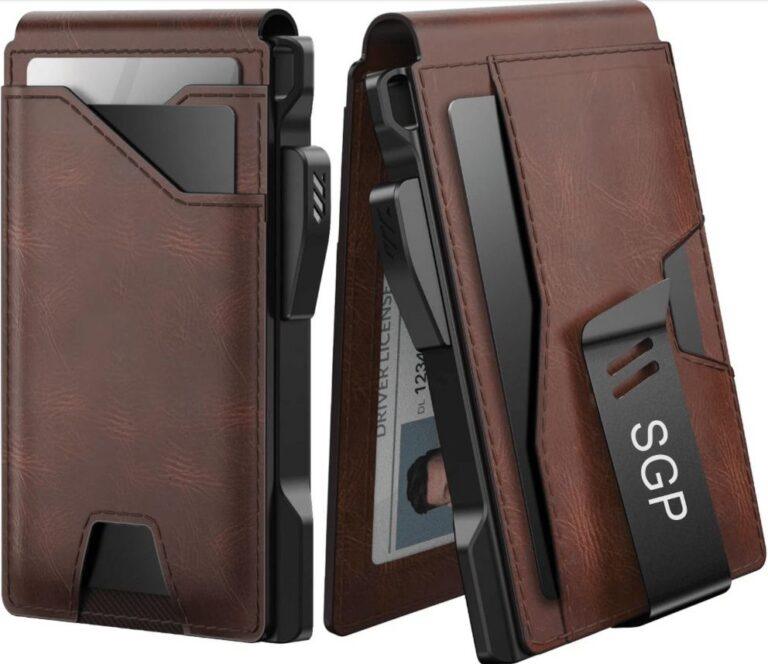
Money clips. A slim, pocket-sized item with room for initials or a short date. Our personalized engraved money clip is a popular pick for groomsmen and Father’s Day, because every clip in a set can carry a different name or monogram.
Keychains. A metal keychain with a leather insert gives you two surfaces to work with. Our personalized metal keychain with engraved leather insert suits new-home gifts, first cars and anniversary presents.
Medals. For a golf tournament, a family game day or a graduation, a personalized laserable medal comes in gold, silver or bronze finishes and carries your own text.
Flasks, rings and kitchen tools. These are part of our regular lineup of made-to-order pieces, and the same idea applies: a short, meaningful line, placed where it will be seen and loved.
Browse the full range on our site to see everything we currently engrave.
Choosing the wording and design
The method matters less than the message. A few things we have learned from engraving gifts:
- Keep it short on small items. A money clip or ring looks best with a name, initials or a date, not a paragraph.
- Choose the placement. Think about how the piece is held or displayed. A date on the back of a flask can be a lovely surprise.
- Double-check spelling and dates. Every personalized item is engraved to order, so a typo travels with the gift. Read your text aloud before you submit it.
- Match the occasion. Weddings suit names and dates, new babies suit birth details, golfers love a hole-in-one date, and anyone relocating loves a home-state design.
- Think about the long haul. Simple, classic wording ages best. If you want ideas, our guide on how to personalize gifts that get kept walks through it.
If you are curious about the terms you will see on product pages, our explainer on laser etching, engraving and marking breaks down the differences in plain language.
Materials and safety: what a good shop checks
One reason to buy from a shop that engraves every day is that the maker knows which materials are safe to laser. It is not a case of putting anything under the beam.
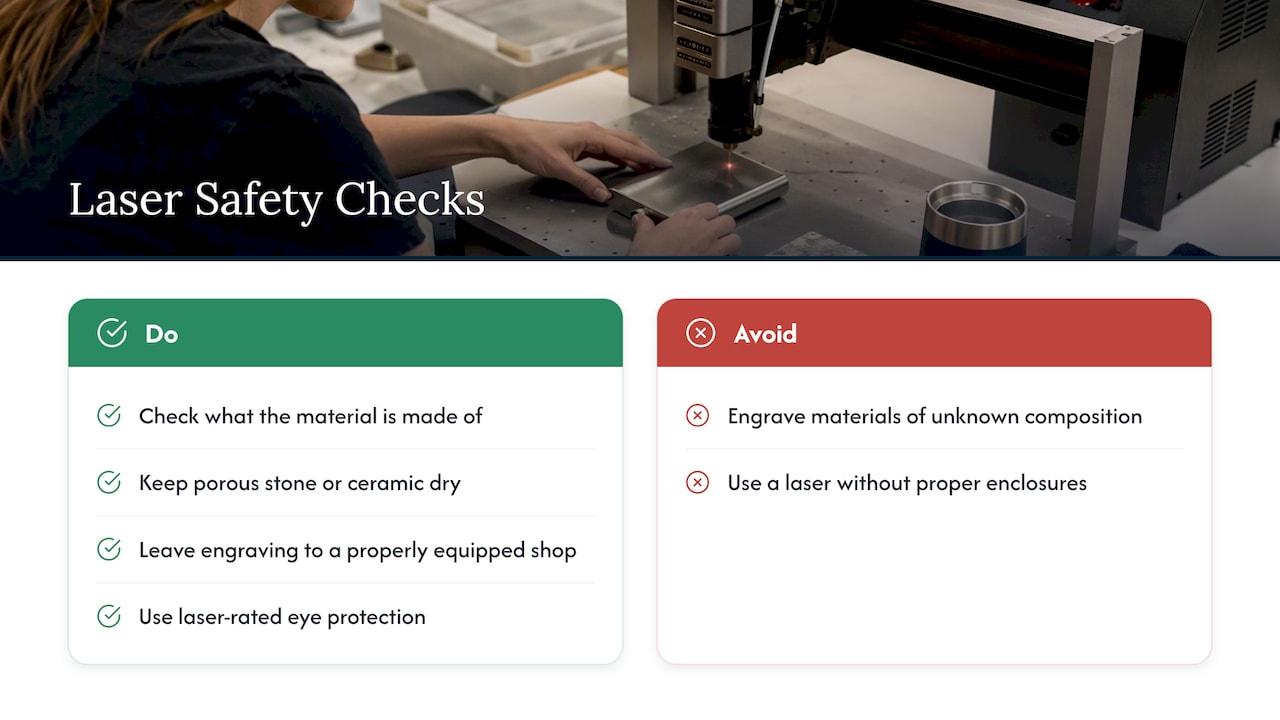
A university laser safety sheet gives a rule worth repeating: never cut or engrave a material if you are unsure what it is made of. The same document explains that some coatings and embedded materials can release toxic or corrosive fumes, and that porous stone or ceramic must be dry. Plated or coated metal items are a good example. The coating, not just the metal underneath, decides whether a piece is safe.
Laser safety is also a real regulatory matter. The FDA regulates laser products under federal rules, and high-powered lasers can seriously injure eyes and skin. That is why we say plainly: leave the engraving to a shop with the proper equipment and enclosures. If you are tempted to try a home laser on a gift, follow the manufacturer’s safety instructions and wear laser-rated eye protection.
If you are wondering what not to bring us, we have written about craft materials that cannot be laser engraved. Reading it first saves you time.
Our perspective: why we chose the laser
When people ask us whether laser engraving has replaced stamping, we answer from the bench, not a factory floor.
We started with lasers because the gifts our customers ask for are personal. Nobody wants the same line on every piece. Each order has its own names, its own dates, its own home state or pet. A laser lets us do that without building anything new for each order. We change the file, load the piece, and engrave it to order in our Georgia shop.
We still have great respect for stamping. A hammered initial on a leather tag has a warmth that a laser does not copy. If that is what you want, we will tell you honestly that stamping is the more authentic route. But when a customer needs a crisp date, a small logo, a full name or a matching set, we reach for the laser every time.
The other thing we love is the confidence it gives people. When you can see exactly how your text will look before it is engraved, you worry less about the gift. That is what we want for every shopper: a thoughtful present, done right, without the stress.
— Gary
Ready to order a personalized metal or wood gift?
We make wood and metal gifts for weddings, anniversaries, holidays, new babies, pet lovers, golfers and anyone moving to a new home. Personalization is entered right on each product page, and every piece is engraved to order in our Georgia shop.
Start at our custom gift creation page if you have something special in mind, or explore our wood and metal gift collection to see finished keepsakes and blanks. Crafters will also like our laser-cut wood cutouts for custom decor projects.
FAQ
Can laser engraving replace metal stamping?
For personalized gifts, yes, in most cases. A laser handles names, dates and artwork with no custom tooling. For high-volume factory parts, stamping is still used because the cost of the die is spread across very large runs, as fabrication shops explain.
What is the difference between engraving and stamping?
Stamping strikes or presses the metal so the surface is displaced, which leaves an impression you can feel. Laser engraving uses a beam to remove or alter a thin layer without touching the piece. Stamping looks handmade and slightly uneven, while laser engraving looks crisp and consistent.
Can I laser engrave a stamp?
Yes, certain materials can be laser engraved to make stamps, but that is a specialized craft project and not something we offer as a gift item. If you are interested in crafting, our wood cutouts and blanks are a better starting point for your own projects.
What materials should not be laser engraved?
Anything whose makeup you are unsure of. Some coatings and embedded materials can release harmful fumes when heated, and wet porous materials can be dangerous, according to university laser safety guidance. Check with the shop before you send or choose an item.
Why are stamping dies so expensive?
A die is a custom-made tool built to produce one shape, so you pay for it before the first part is made. One fabrication comparison puts stamping tooling at about $10,000 versus no tooling for laser. That cost only makes sense when it is spread over a very large run.
Sources
- Etching, Stamping, Water jet or Laser: Which to Choose? (Conard Corporation)
- Pros & cons of parts marking methods (CTE Magazine)
- Laser Engraving and Hand Stamping: All You Need To Know
- Process Specification for Laser Marking & Laser Engraving (NASA)
- Laser Cutter Safety Materials (University of Victoria)
- Laser Products and Instruments (FDA)
Recommended